
Safaricom's new board appointments show what Vodacom's 55% control looks like in practice
Safaricom's appointment of two senior Vodacom executives is an early sign of how majority ownership is translating into governance, fintech oversight and organisational influence.
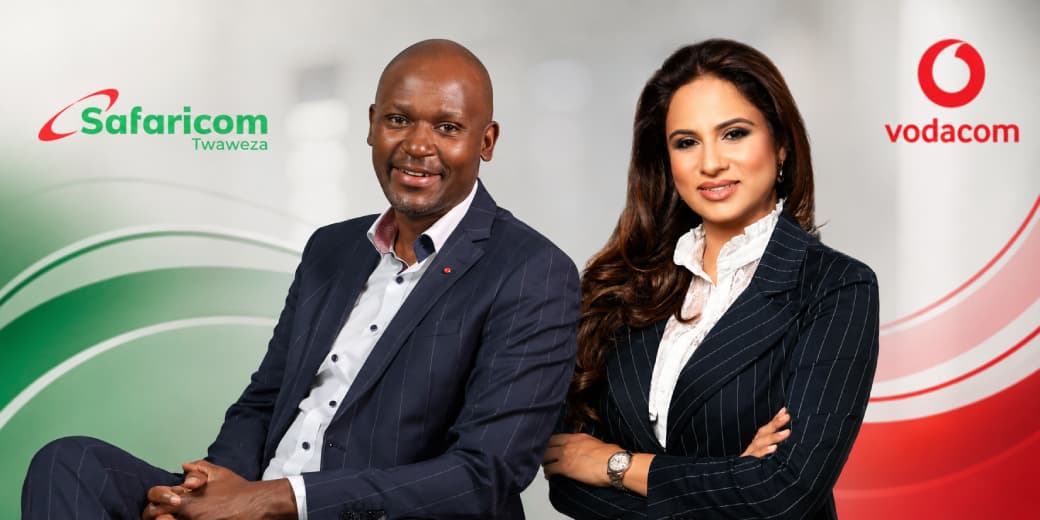
Safaricom has appointed two senior Vodacom Group executives to its board, providing one of the clearest early signs of how Vodacom's new majority ownership of Kenya's largest telecommunications company is beginning to translate into governance.
Mariam Cassim, Chief Executive Officer of Vodacom Fintech Group and Group Partnerships, and Matimba Mbungela, Vodacom Group's Chief Officer for Human Resources, have been appointed as non-executive directors of Safaricom effective August 13, 2026, subject to regulatory approvals.
They replace James Ludlow and Dr. John Kipngetich Mosonik, who resigned as non-executive directors with effect from the same date.
Taken alone, the announcement could look like a routine board refresh.
It is not.
The appointments come weeks after Vodacom completed a transaction that lifted its effective Safaricom shareholding to approximately 55%, giving the South African group majority ownership of a company that sits at the centre of Kenya's communications and mobile-money economy.
For the transaction mechanics and immediate public-interest questions, read our earlier explanation of Vodacom's majority control.
Safaricom shareholders then approved governance changes at the July 31 AGM that strengthened Vodafone Kenya's formal nomination rights at board level.
The result is that Safaricom's changing ownership is now becoming visible in the people sitting around the board table.
And the profiles of the two incoming directors are revealing.
One comes from fintech.
The other comes from organisational transformation and talent.
That combination says a great deal about the areas Vodacom considers strategically important in Safaricom's next chapter.
What Safaricom announced
Safaricom's board said Cassim and Mbungela were appointed as non-executive directors effective August 13, subject to regulatory approvals.
The same board notice confirmed the resignation of Ludlow and Mosonik.
The timing is important because the change follows a much larger restructuring of Safaricom's shareholder base.
On June 30, Vodacom completed the acquisition of an additional 20% effective interest in Safaricom.
According to Vodacom, that additional interest consisted of:
- A 15% Safaricom stake acquired from the Government of Kenya.
- A further effective 5% interest acquired from Vodafone Group.
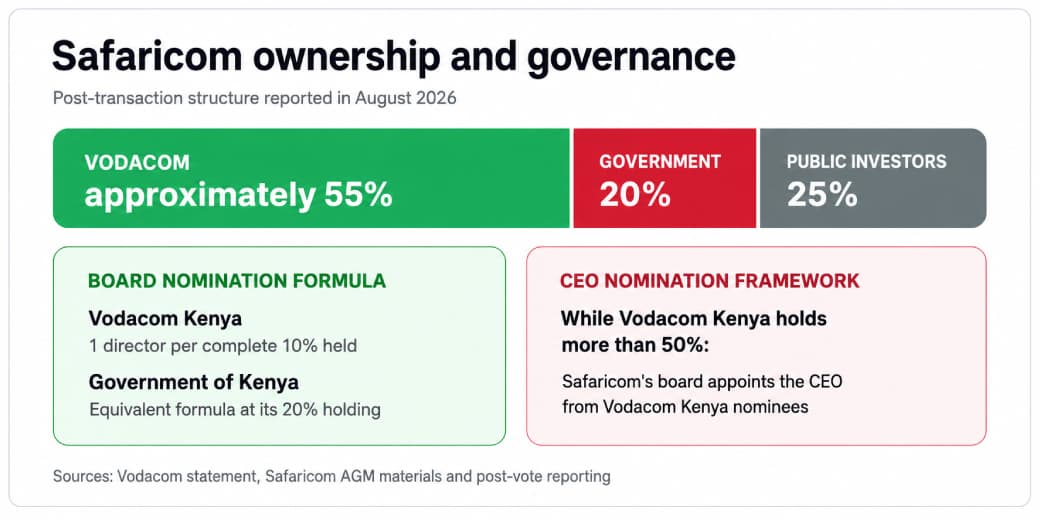
The transaction lifted Vodacom's Safaricom interest from roughly 35% to approximately 55%.
The Government of Kenya retained 20%.
Public investors continued to hold the remaining 25% through the Nairobi Securities Exchange.
Those investors are also weighing capital returns against reinvestment after Safaricom's KSh 80.13 billion dividend.
That moved Safaricom from an associate in Vodacom's accounts to a business whose financial results can be consolidated into the wider Vodacom Group.
Ownership changed on paper in June.
The August board appointments show part of what that change means operationally.
Mariam Cassim brings Vodacom's fintech strategy directly into the room
Cassim is one of the more strategically interesting appointments Safaricom could have made at this moment.
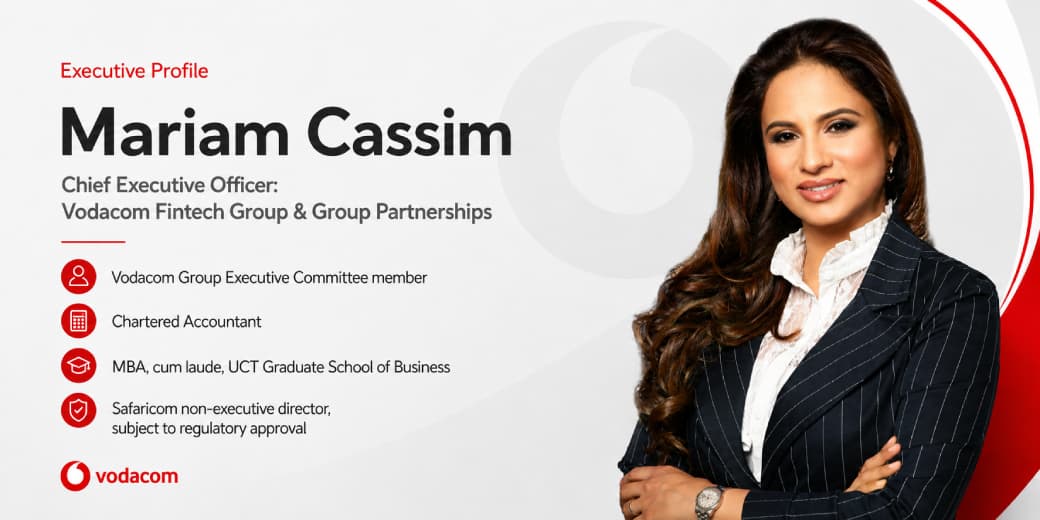
Vodacom lists her as Chief Executive Officer of Vodacom Fintech Group and Group Partnerships and a member of the Vodacom Group Executive Committee.
She is responsible for the group's fintech strategy and financial-services growth across its portfolio.
She is a Chartered Accountant and holds an MBA from the University of Cape Town Graduate School of Business, where she graduated cum laude.
Her career has included corporate finance, commercial management, mergers and acquisitions, partnership development and financial-services leadership.
Vodacom credits her with helping scale its South African fintech operation into a significant profit centre.
That experience sits directly beside Safaricom's most strategically important asset outside conventional connectivity: M-Pesa.
M-Pesa is no longer simply a money-transfer product.
The regional opportunity is already visible in products such as M-Pesa Ethiopia's cardless ATM withdrawals, where partnerships extend a mobile wallet into existing banking infrastructure.
It is a platform around which Safaricom has built payments, merchant services, credit partnerships, savings, wealth products, business services and a growing ecosystem of financial tools.
Vodacom has also made financial services one of the central pillars of its broader African growth strategy.
Putting its senior fintech executive on Safaricom's board creates a much more direct bridge between those two ambitions.
Why Cassim's appointment matters for M-Pesa
A non-executive director does not run M-Pesa day to day.
That distinction matters.
Safaricom's executives remain responsible for operational management.
The board provides oversight, governance, strategic challenge and approval around major decisions.
Cassim's influence is therefore more likely to appear in the questions the board asks and the strategic choices it scrutinises.
Those questions may include:
- How quickly should expand into new financial categories.
- Which partnerships Safaricom should build with banks, fintechs and global payment companies.
- How M-Pesa's Ethiopia business should evolve.
- How Safaricom can improve cross-border money movement.
- Whether successful M-Pesa products can be replicated elsewhere in the Vodacom footprint.
- How customer data, risk and financial regulation should be governed as M-Pesa becomes more complex.
- Where Safaricom should build internally and where partnerships make more sense.
This does not mean every Vodacom fintech product will simply be imported into Kenya.
Safaricom operates in a distinctive regulatory and competitive environment.
M-Pesa itself is one of the assets Vodacom wants to learn from.
The strategic relationship can therefore work in both directions.
Vodacom can bring group-scale partnerships and fintech experience into Safaricom.
Safaricom can provide M-Pesa expertise that Vodacom wants to apply elsewhere.
That exchange is one of the reasons the acquisition was strategically valuable in the first place.
Matimba Mbungela represents a very different kind of integration
If Cassim signals financial-services ambition, Mbungela signals organisational integration.
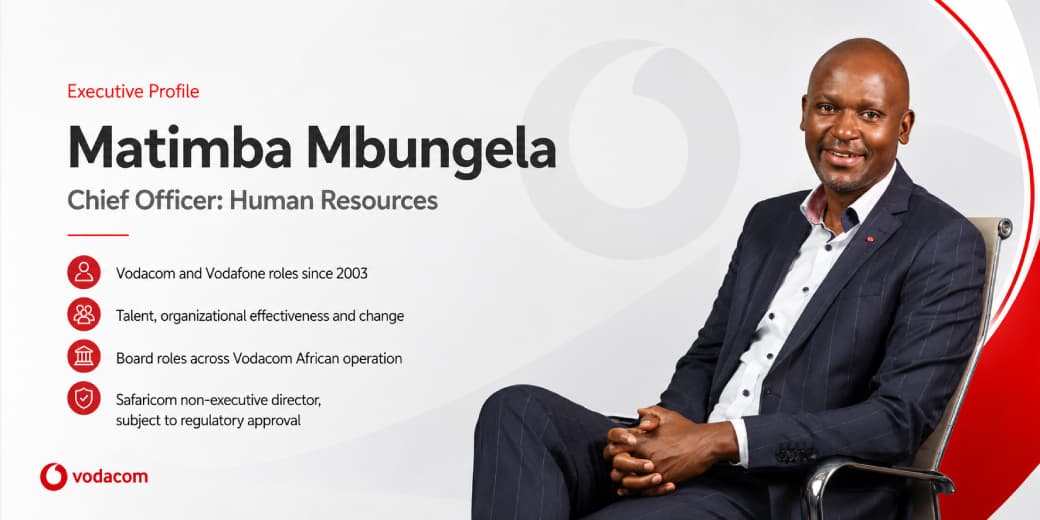
Mbungela has served as Vodacom Group's Chief Officer for Human Resources since 2014.
Vodacom says he has worked across the Vodacom and Vodafone group since 2003 and has held senior positions covering organisational effectiveness, change and talent across Africa, the Middle East and Asia Pacific.
His previous experience also includes senior human-resources roles at BMW South Africa and Unilever.
He currently serves as a non-executive director of Vodacom Tanzania, Vodacom Mozambique and Vodacom Lesotho.
That makes his appointment to Safaricom notable for a different reason.
Major acquisitions are financial transactions on completion day.
They become organisational transactions afterward.
Companies need to decide how independent a subsidiary remains, where group processes are harmonised, how talent moves across markets and which functions can benefit from scale.
Mbungela has spent much of his career dealing with exactly those questions.
The people strategy could become surprisingly important
Safaricom is transitioning from a Kenyan telecommunications operator into a broader regional technology and financial-services group.
That creates workforce pressure.
The company increasingly needs talent in:
- Software engineering
- Cybersecurity
- Cloud services
- Data science
- Artificial intelligence
- Financial services
- Product management
- Enterprise technology
- Network engineering
- Regulation and compliance
It is simultaneously running a large Kenyan business and building a significant operation in Ethiopia.
Vodacom has its own operations across several African markets.
A closer relationship creates opportunities for leadership development, shared expertise and movement of specialised talent.
It also creates a legitimate governance concern.
Safaricom has historically had a strong Kenyan identity and substantial local management depth.
Closer integration with Vodacom should not become a quiet replacement of local leadership with group appointments.
Safaricom's revised governance framework continues to recognise the importance of maintaining a predominantly Kenyan character in senior leadership.
That tension will be worth watching.
Group integration can expand opportunity.
Poorly handled integration can make employees feel the important decisions have moved somewhere else.
The board changes are connected to July's governance overhaul
The appointments cannot be separated from Safaricom's July 31 AGM.
Our earlier Safaricom board and CEO governance analysis explains how those amended articles turn ownership into formal influence.
Shareholders approved 14 special resolutions that revised the company's Articles of Association following Vodacom's move to majority ownership.
Among the most consequential changes is a director nomination formula tied to shareholding.
Vodafone Kenya is entitled to appoint one director for every complete 10% stake it holds.
At approximately 55%, that implies five nomination rights under the formula.
The Government of Kenya, with its 20% holding, has an equivalent formula that implies two.
The revised framework also gives Vodafone Kenya a powerful role in CEO succession while it owns more than half of Safaricom.
The board retains the formal appointment decision, but the chief executive must be selected from nominees submitted by Vodafone Kenya while that ownership threshold continues to apply.
These rules make the latest board appointments more than ordinary vacancies being filled.
They are occurring inside a governance system that has explicitly been rewritten around the new ownership structure.
Vodacom's 55% stake does not mean Safaricom stops being Safaricom
Majority ownership can be misunderstood.
Vodacom does not suddenly become the management team sitting at every Safaricom desk.
Safaricom remains a separately listed Kenyan company with its own board, executives, minority shareholders, regulatory obligations and Government of Kenya shareholder.
The company also operates in Ethiopia under a separate regulatory environment and local operating structure.
The new ownership does, however, give Vodacom much stronger influence over strategic direction.
It can now consolidate Safaricom financially.
It holds formal board nomination rights.
Its relationship with Safaricom is moving from significant shareholder influence to majority shareholder control.
The incoming directors are one visible expression of that change.
Why Vodacom wanted control in the first place
Vodacom has been explicit about the strategic importance of Safaricom.
When the transaction completed, Vodacom said the acquisition strengthened its East African position and expanded its financial-services footprint.
Safaricom combines several assets Vodacom values:
- A dominant Kenyan connectivity business.
- M-Pesa and its financial-services ecosystem.
- A growing Ethiopian operation.
- Enterprise, cloud and digital services.
- One of Africa's strongest consumer technology brands.
Vodacom also said the transaction allowed it to lift the share of financial services in group service revenue significantly.
This is why the Cassim appointment feels especially logical.
Safaricom is not simply another mobile network inside the group.
Its fintech capability is one of the reasons the wider group wanted greater control.
The Government of Kenya still matters
The Treasury's holding has fallen from 35% to 20%.
That is a meaningful reduction.
Twenty percent is still a substantial strategic stake in one of Kenya's most important companies.
The Government also retains board nomination rights through the revised articles and specific protections around major strategic decisions.
Safaricom therefore enters an unusual governance era.
Vodacom is the majority shareholder.
The Kenyan state remains a powerful minority shareholder.
Public investors still own one quarter of the company.
Those interests will not always be identical.
Good governance will require the board to act for Safaricom as a company rather than behave as a meeting of shareholder delegations.
That distinction becomes more important when nomination rights are clearly linked to ownership.
What shareholders should watch next
The appointment of Cassim and Mbungela probably will not be the last governance story following the acquisition.
Several questions deserve attention.
Does Vodacom use all of its board nomination capacity?
The revised articles create a formula that can support five Vodacom-linked directors at the current ownership level.
The evolving composition of the board will show how that right is exercised.
How independent does Safaricom's strategy remain?
Safaricom can benefit from Vodacom's scale without becoming a copy of another group company.
The balance will matter most in fintech, technology procurement, talent and regional expansion.
What happens when the next CEO is chosen?
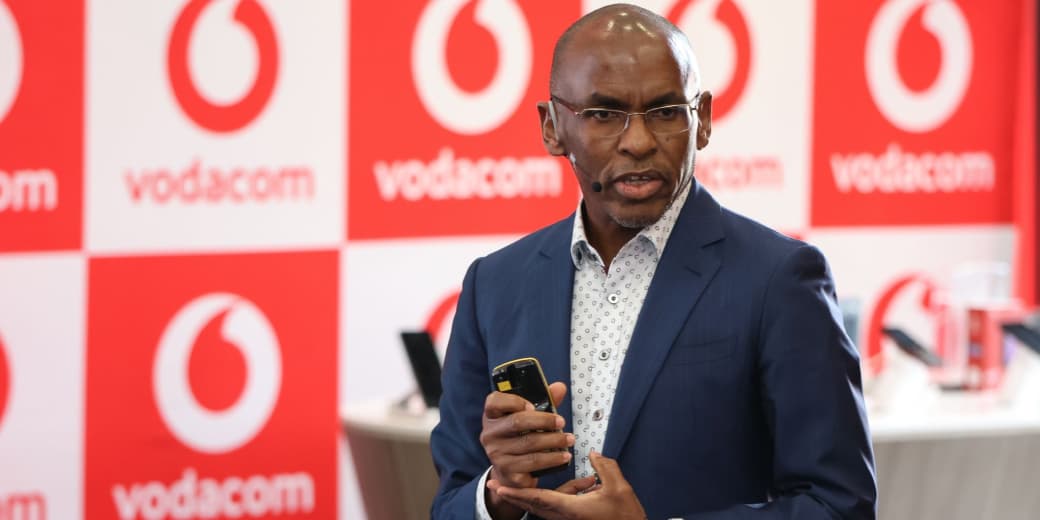
Peter Ndegwa remains Safaricom's chief executive.
The revised articles change the framework for any future succession by giving Vodafone Kenya the right to provide the candidate list while it owns more than 50%.
That will be one of the clearest tests of the new governance architecture when the time eventually comes.
Does M-Pesa become more integrated with Vodacom fintech?
Cassim's board appointment makes this one of the most interesting strategic questions.
Integration could create more cross-border services and group-level scale.
It must still make sense for M-Pesa customers and regulators in each market.
How will local talent be protected and developed?
Mbungela's experience can help Safaricom access group-level talent systems.
The company should also continue developing Kenyan and Ethiopian leadership rather than treating local talent as subordinate to group structures.
The tecMAMBO take
The appointment of Mariam Cassim and Matimba Mbungela is not dramatic because two executives changed seats.
It is important because it shows what Vodacom's acquisition begins to look like once ownership moves from a transaction document into day-to-day corporate governance.
The choice of directors is revealing.
Cassim connects Safaricom directly to Vodacom's group fintech leadership at a time when M-Pesa is central to both companies' growth ambitions.
Mbungela brings deep experience in talent, organisational change and the difficult work of aligning businesses across several markets.
Those are sensible capabilities to put on the board.
They also make Vodacom's influence more visible.
That is not inherently a problem.
A shareholder owning approximately 55% of a company is expected to influence its governance.
The question for Safaricom's customers, employees, minority investors and the Kenyan state is what that influence produces.
The best outcome is a stronger Safaricom that gains access to Vodacom's scale, capital, talent and partnerships while preserving the local product intuition and execution that made Safaricom valuable enough to acquire in the first place.
The weaker outcome would be centralisation for its own sake.
That is why these two board appointments deserve more attention than the usual corporate notice.
Vodacom already owns the majority.
Now we are beginning to see how it intends to govern it.
FAQ
Who are Safaricom's new board members?
Safaricom appointed Mariam Cassim and Matimba Mbungela as non-executive directors effective August 13, 2026, subject to regulatory approvals.
Who is Mariam Cassim?
Cassim is Chief Executive Officer: Vodacom Fintech Group & Group Partnerships and a member of the Vodacom Group Executive Committee.
Who is Matimba Mbungela?
Mbungela is Vodacom Group's Chief Officer: Human Resources and has worked across Vodacom and Vodafone in senior talent and organisational-change roles.
Which Safaricom directors left the board?
James Ludlow and Dr. John Kipngetich Mosonik resigned as non-executive directors effective August 13, 2026.
How much of Safaricom does Vodacom own?
Vodacom says its effective shareholding increased to approximately 55% after completing an additional 20% effective acquisition on June 30, 2026.
How much Safaricom does the Government of Kenya own?
The Government of Kenya retained a 20% stake after selling 15% as part of the June transaction.
How many Safaricom directors can Vodafone Kenya nominate?
The approved formula provides one director appointment right for every complete 10% shareholding. At approximately 55%, that implies five rights for Vodafone Kenya.
Does Vodacom choose Safaricom's CEO?
Safaricom's board formally appoints the CEO. While Vodafone Kenya holds more than 50%, the approved framework requires the board to choose from nominees submitted by Vodafone Kenya.
Sources
Share this story
Enjoyed this? Share it with someone who'd appreciate it.
Ask MAMBO
Have a plain-English question about this topic? Send it in and we may answer it in a future guide.
Ask a questionRelated reading
Vodacom's new Safaricom powers go far beyond owning more shares
Vodacom's reported 55 percent stake now comes with stronger board and executive influence over a company that carries Kenya's communications and money.
The AGM that formalises Vodafone's grip on Safaricom
Safaricom shareholders will vote on fourteen resolutions that turn Vodafone Kenya's 55 percent stake into formal boardroom control.
Government banks Sh244.5bn from the Safaricom sale
Kenya has received about Sh244.5 billion from the Vodacom Safaricom transaction, with the money headed into the National Infrastructure Fund.