

M-Pesa Ethiopia users can now turn wallet balance into cash at Bank of Abyssinia ATMs
A new Bank of Abyssinia integration gives M-Pesa Ethiopia customers another way to cash out, turning existing ATM infrastructure into part of the mobile-money network.
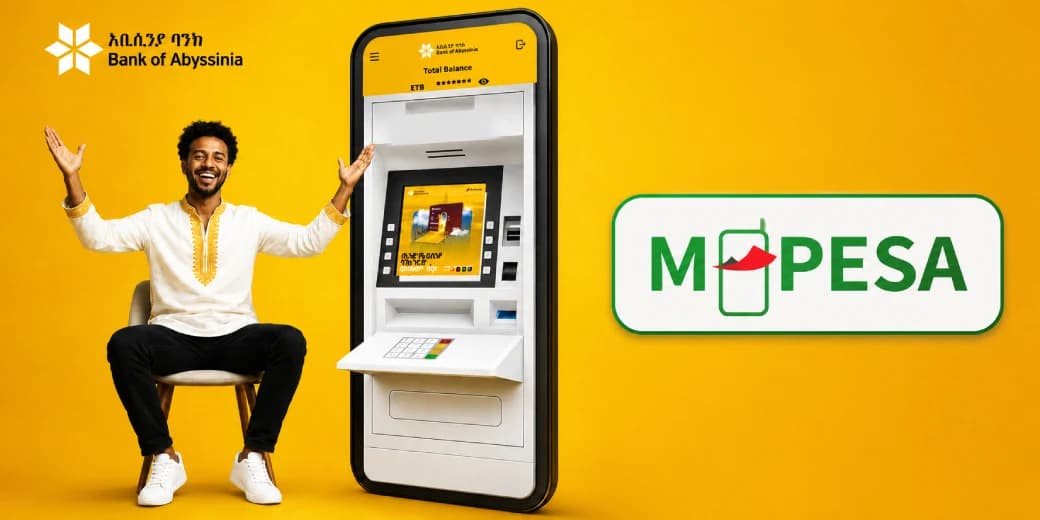
M-Pesa Ethiopia has added cardless ATM withdrawals through Bank of Abyssinia.
Customers can initiate a transaction through M-Pesa and collect cash from supported ATMs without carrying a physical bank card.
M-Pesa says the service is available around the clock and transactions are processed in real time.
On the surface, this is a cash feature inside a digital-money product.
Strategically, it is about something larger: interoperability between a mobile wallet and traditional banking infrastructure.
Cash still matters in a digital-money market
Mobile money is often described as a replacement for cash.
In practice, it works best when users can move between the two easily.
A customer may receive salary, remittance or business revenue digitally and still need cash for:
- Transport
- Local merchants
- Informal markets
- Services without digital acceptance
- Areas with unreliable connectivity
Traditional mobile money relies heavily on agents for that conversion.
ATMs add another access channel.
They operate outside some agent opening hours.
They can also reduce dependence on the cash position of an individual agent.
The ATM becomes a mobile-money endpoint
The important change is conceptual.
An ATM has traditionally been tied to a bank account and bank-issued card.
Cardless M-Pesa withdrawal lets the same machine serve as a cash endpoint for a wallet.
The customer authorises the transaction digitally and completes the cash-out at a supported Bank of Abyssinia terminal.
If additional banks join later, Ethiopia's existing ATM estate can become part of M-Pesa's distribution network without Safaricom Ethiopia building every cash location itself.
One banking partner creates a useful feature.
Several participating banks could create infrastructure.
Bank of Abyssinia is the first step
M-Pesa Ethiopia has indicated that it wants to expand the cardless model to more banking partners.
That intention should not be reported as if those integrations are already complete.
The service will become substantially more valuable as coverage increases.
The practical user experience depends on:
- ATM location
- Uptime
- Fees
- Withdrawal limits
- Authentication
- Reversal handling
- Customer support
Not all of those commercial details were clear in the launch information available during preparation of this article.
tecMAMBO therefore should not describe the service as cheaper than agent cash-out without a verified fee schedule.
Convenience and price are separate claims.
Ethiopia is not Kenya with a different flag
M-Pesa's success in Kenya can make international expansion look simple from Nairobi.
It is not.
Ethiopia has its own banking system, regulation, mobile-money competitors and consumer behaviour.
M-Pesa Ethiopia needs to build relevance inside that environment.
Interoperability helps.
A wallet becomes more useful when it connects to infrastructure people already recognise.
That includes banks.
The future of mobile money may therefore be less about "banks versus wallets" and more about who builds the most useful bridges between them.
ATMs can reduce pressure on agents
Agents remain central to mobile money.
They provide:
- Cash-in
- Cash-out
- Onboarding support
- Local trust
- Customer assistance
They can also face liquidity constraints.
An agent can run out of cash.
An ATM is connected to a bank's cash-management system.
Adding ATM withdrawal can distribute customer demand across more channels.
That can improve reliability during busy periods.
It does not make agents obsolete.
Outside dense urban areas, the agent network may remain much more important than an ATM network.
The two channels solve different access problems.
Security decides whether cardless feels safe
Removing the physical card places more responsibility on digital authentication.
The system needs strong:
- Device security
- authentication
- Short-lived authorisation
- Transaction limits
- Fraud monitoring
- Phone-loss procedures
The user should also receive immediate confirmation.
The convenience should not turn a stolen unlocked phone into an easy ATM credential.
Clear timeout rules and transaction-specific authorisation are particularly important.
The broader interoperability story
Financial systems become more useful when value can move safely between platforms.
Wallet-to-bank and bank-to-wallet connectivity reduce the friction that traps money inside one provider.
Cardless ATMs extend the same idea to physical cash.
The strongest digital-finance network is not necessarily the one that forces every transaction to remain inside its own ecosystem.
It is the one that lets users move value safely between the places they actually need it.
What Kenya can learn from Ethiopia
Kenya already has mature mobile money and extensive banking infrastructure.
The Ethiopian partnership is still useful as a design example.
Financial inclusion improves when existing infrastructure can be reused instead of duplicated.
Banks do not need to lose relevance when wallets grow.
Their rails can become part of a broader access network.
The competitive question becomes who provides the best user relationship while sharing more of the underlying infrastructure.
The tecMAMBO take
M-Pesa Ethiopia adding ATM withdrawals sounds less futuristic than a new AI feature.
That is precisely why it matters.
Useful fintech often wins by removing ordinary inconvenience.
A wallet balance becomes more valuable when the customer knows it can be reached through agents, merchants, banks and ATMs.
The next step is scale.
If M-Pesa adds more banking partners and keeps fees, authentication and reversals predictable, the ATM can become another invisible bridge between mobile money and Ethiopia's formal financial system.
Sources
Share this story
Enjoyed this? Share it with someone who'd appreciate it.
Ask MAMBO
Have a plain-English question about this topic? Send it in and we may answer it in a future guide.
Ask a questionRelated reading
Safaricom's KSh 80.13 billion dividend is a victory for shareholders and a test for growth
The record payout shows renewed confidence after years of Ethiopia investment. It also raises the question of how much cash Safaricom should return versus reinvest.
Visa's new East Africa chief comes from mobile money, and that changes the strategy
Visa has appointed an executive who grew a mobile money challenger. Her task is to connect cards, wallets, banks and merchants across seven markets.
Safaricom's new board appointments show what Vodacom's 55% control looks like in practice
Safaricom's appointment of two senior Vodacom executives is more than a routine board refresh. It shows how the telco's new majority ownership is beginning to shape governance.