

Insta360 just turned the GO Ultra into a wearable Gemini assistant
Insta360 has begun rolling out firmware version 1.8.91 for the GO Ultra. The headline feature is Kira, a new AI Voice Assistant whose question-and-answer capability uses Google's Gemini models.
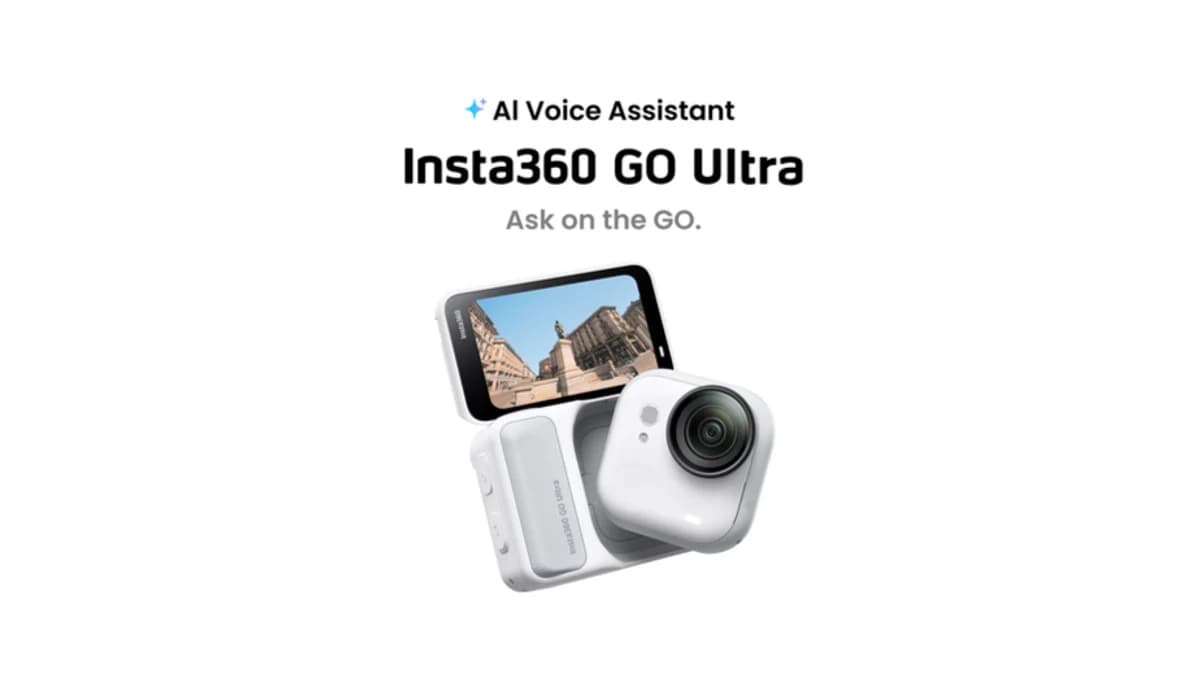
Insta360 has begun rolling out firmware version 1.8.91 for the GO Ultra.
The headline feature is Kira, a new AI Voice Assistant whose question-and-answer capability uses Google's Gemini models.
The camera can respond to voice prompts, translate conversations and use an Ask with Photo mode to analyse what the lens is seeing.
It makes the GO Ultra look less like a conventional action camera and more like AI smart glasses without the glasses.
What you need to know
- 1.8.91 adds the .
- Rollout began on 7 August.
- Insta360 says the Q&A function uses Gemini.
- Ask with Photo uses camera context.
- Voiceprint recognition helps distinguish the user's voice.
- Translation and language availability may vary.
- AI answers can be wrong.
Why a camera is a natural AI device
Multimodal AI needs context.
A phone can see only when the user deliberately opens the camera.
A wearable camera is already pointed toward the environment.
That makes questions natural: What building is that? Translate this sign. What am I looking at? What does this menu say? Tell me about this landmark.
The interface becomes: look, ask, hear.
That is simpler than unlocking a phone and framing a separate photo.
Ask with Photo changes the product
Action cameras traditionally record for later.
Ask with Photo makes the camera useful in the present.
The image becomes input to an AI system rather than only media.
That can help travellers, cyclists, hikers, creators, students and accessibility users.
The value depends on .
An assistant that takes twenty seconds to identify a sign is less useful than simply using the phone.
Wearable AI needs speed because the physical world keeps moving.
Voiceprint recognition matters in noisy places
Action cameras operate in terrible audio environments.
Wind, traffic, crowds and engines make voice commands difficult.
Voiceprint recognition attempts to prioritise the owner's voice.
That could reduce false activation.
It also creates security questions.
How is the voice model stored? Can another person trigger commands? Can the camera be tricked by recorded audio?
Insta360 should document what is processed locally and what reaches cloud services.
Translation is a killer travel feature
Real-time translation is one of the clearest practical uses for generative AI.
A wearable camera can see text while microphones hear conversation.
That combination could turn the device into a lightweight travel assistant.
Accuracy still matters.
Translation errors can be funny in a restaurant and serious in medical or legal situations.
The product should make uncertainty visible.
AI fluency can sound more reliable than it is.
Smart glasses without social baggage
Camera glasses face a design problem.
People around the wearer may not know whether they are being recorded.
A GO Ultra is visually identifiable as a camera.
That may make social expectations clearer.
The user can clip it to clothing instead of wearing cameras at eye level.
It also lacks a display in front of the eye.
That keeps the hardware simpler and lighter.
The trade-off is that answers need to arrive through audio or a connected device.
Privacy becomes central
Insta360's privacy documentation says AI capabilities rely on Gemini.
Users should understand what image is sent, what audio is sent, whether data is stored, which account is involved, how long history remains and how to disable AI features.
The camera is now capable of sending environmental context to an AI service.
That deserves clearer consent than a firmware update notification.
Why this threatens action-camera rivals
Camera companies can no longer compete only on sensor, , stabilization and battery.
AI software can extend the useful life of hardware after purchase.
That creates customer loyalty.
If Insta360 keeps adding capabilities to existing cameras, buyers may value the software roadmap as much as launch specifications.
DJI's incoming Osmo 360 II therefore enters a market where intelligence is becoming part of camera quality.
The timing matters because DJI's Osmo 360 II launch is confirmed while its best specifications remain leaks.
The tecMAMBO take
Kira is interesting because it changes what an action camera is for.
The GO Ultra no longer exists only to remember what happened.
It can help interpret what is happening.
That is a bigger shift than another resolution increase.
The risk is familiar.
A camera that sees the world for you also creates a new path for the world around you to become AI data.
FAQ
Which firmware adds Kira?
Insta360 lists firmware version 1.8.91.
When did rollout begin?
Gradual rollout began on 7 August 2026.
Does it use Google Gemini?
Insta360 says the AI Voice Assistant Q&A capability is powered by Gemini.
What is Ask with Photo?
It lets the assistant analyse a photo or camera view as context for a question.
Can the AI be wrong?
Yes. Insta360 explicitly warns that AI output may be inaccurate or incomplete.
Sources
Share this story
Enjoyed this? Share it with someone who'd appreciate it.
Ask MAMBO
Have a plain-English question about this topic? Send it in and we may answer it in a future guide.
Ask a questionRelated reading
Apple's next health device may sit on your face, not your wrist
Apple appears to be spreading sensing across glasses and earbuds, but privacy, battery life and clinical credibility will determine whether it works.

Apple's camera-equipped AirPods just leaked, and the privacy question is bigger than the hardware
A leaked Apple video inside macOS Tahoe 26.7 shows camera-equipped AirPods using Visual Intelligence. Here is what appears real and what remains unconfirmed.
Can your smartwatch predict illness, or just make you anxious?
Wearables are getting better at spotting when your body behaves differently from normal. That can be useful, but an alert is a clue, not a diagnosis.