

Apple's camera-equipped AirPods just leaked, and the privacy question is bigger than the hardware
A leaked Apple video inside macOS Tahoe 26.7 shows camera-equipped AirPods using Visual Intelligence. Here is what appears real and what remains unconfirmed.
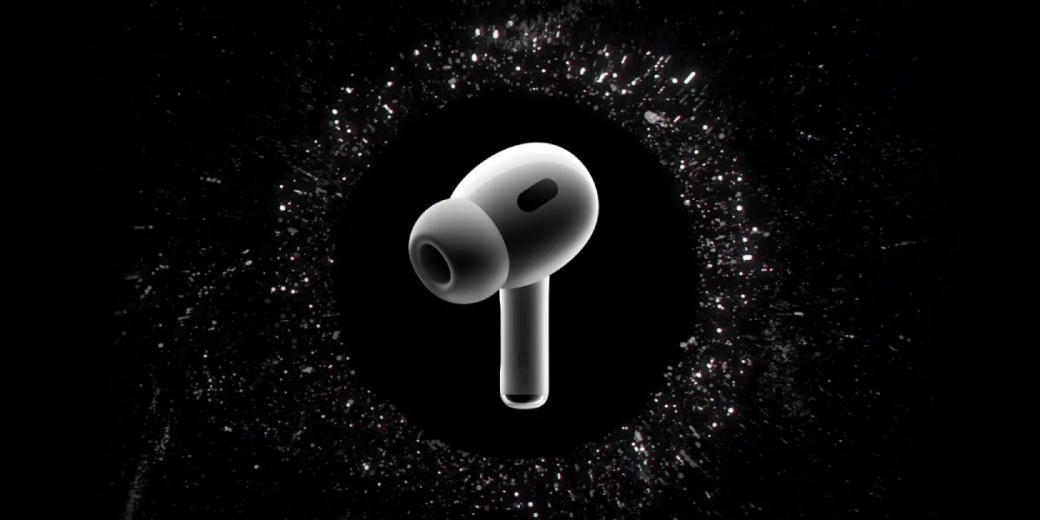
Apple has not formally announced camera-equipped AirPods.
Its own software appears to have done part of the announcement for it.
A video discovered inside the macOS Tahoe 26.7 release candidate shows a user holding up a book while wearing unreleased AirPods. The narration describes a Visual Intelligence experience that lets the user ask Siri to save information from the world around them.
The earbuds appear to contain camera hardware capable of feeding visual context into Apple's intelligence system.
That is much stronger evidence than an ordinary supply-chain rumour.
It is still not a retail launch.
Apple has not published final specifications, pricing, or availability for the product.
The safest description is therefore simple: camera-equipped AirPods now look very real, but the final product remains unannounced.
What the leaked video actually shows
The leaked material demonstrates a use case rather than a camera product in the conventional sense.
The user is not taking vacation photographs.
The cameras appear to help Siri understand what the wearer is looking at.
That changes the role of the earbuds.
AirPods have traditionally been an audio endpoint for music, calls, notifications, Siri and .
Adding visual sensors turns them into a context sensor.
The device can potentially hear the user's request, see part of the environment and provide an answer without requiring the user to take out an iPhone.
That is a much more ambitious product category than wireless earbuds.
Why Apple may want cameras on your ears
AI assistants become more useful when they have context.
A phone already has powerful cameras, but the phone usually lives in a pocket or hand.
Earbuds remain on the body for long periods.
A wearable camera can provide the assistant with a view of what is directly in front of the user.
That could eventually support tasks such as:
- Identifying objects
- Reading signs
- Remembering information
- Navigation assistance
- Accessibility
- Visual search
- Environmental context for Siri
The attraction is obvious.
The privacy problem is equally obvious.
Tiny cameras are socially different from phone cameras
When someone raises an iPhone and points it at you, the social signal is clear.
You know a camera may be active.
A camera hidden inside an earbud does not provide the same signal.
That creates a difficult design question.
How does another person know when the device is capturing visual information?
Apple has dealt with related issues before.
MacBooks use camera indicators. AirTags generated scrutiny around unwanted tracking. Meta's smart glasses include a visible capture indicator.
A visual-intelligence earbud will need an equally understandable social contract.
Technical privacy protections are not enough if the people around the wearer cannot tell what the device is doing.
Visual Intelligence is not necessarily video recording
The existence of cameras does not automatically mean Apple is building a replacement for a GoPro.
Current reporting indicates the system is focused on low- visual data for contextual AI tasks.
That may reduce some risk.
It does not remove it.
Even a low-resolution image can contain faces, documents, screens, home interiors, location clues and personal information.
The most important privacy details will therefore be:
- Whether processing occurs on-device
- Whether images are stored
- How long they persist
- When cloud processing is used
- Whether a hardware indicator activates
- Whether third-party apps can access the sensors
- Whether a user can disable them completely
None of those should be guessed before Apple publishes the final product documentation.
AirPods are becoming an AI interface
The broader strategy is easier to see.
Apple already has the iPhone as a screen.
The Watch provides glanceable information.
AirPods can become the interface that listens, speaks and senses.
If Siri becomes more capable in 2026, Apple needs hardware that makes the assistant feel present rather than trapped inside an app.
Camera-equipped AirPods fit that strategy.
They also compete indirectly with AI glasses.
Meta puts cameras in glasses because glasses naturally face forward.
Apple may be trying to build some of that context into a product category it already dominates.
That could be a powerful advantage.
Hundreds of millions of people already understand how to wear AirPods.
They do not need to adopt an entirely new form factor.
The privacy standard will matter more than megapixels
If Apple eventually launches the product, the specification sheet will attract attention.
People will ask about sensor count, battery life and supported iPhones.
Those details are important.
The bigger question is whether Apple can make the product socially acceptable.
A wearable AI device should answer three questions clearly:
- When is it sensing the environment?
- What leaves the device?
- How can people nearby understand that sensing is happening?
A clever visual assistant that makes everyone else feel watched is a weak consumer product.
The tecMAMBO take
The interesting part of this leak is not that Apple found space for a tiny camera.
The interesting part is what happens when ordinary audio accessories become environmental sensors.
If Apple gets the privacy design right, Visual Intelligence could make AirPods dramatically more useful for navigation, accessibility and everyday recall.
If it gets the social signal wrong, camera earbuds could become one of those technologies that makes everyone around the owner uncomfortable.
Apple has spent years selling privacy as part of its brand.
Camera-equipped AirPods may become one of the hardest tests of whether that promise can survive the age of wearable AI.
Sources
Ask MAMBO
Have a plain-English question about this topic? Send it in and we may answer it in a future guide.
Ask a questionRelated reading
 MAMBO Take
Apple's next health device may sit on your face, not your wrist
Apple appears to be spreading sensing across glasses and earbuds, but privacy, battery life and clinical credibility will determine whether it works.
 Should you care?
Samsung goes Ultra: everything announced at the London Unpacked, from a 4.1mm Fold to Gemini glasses
Samsung's London Unpacked delivered the first Ultra foldable at 4.1mm, a wider Fold8, the Flip8, two new watches, and Gemini-powered smart glasses. Every announcement, explained.
 Should you care?
Apple sues OpenAI, and the age of polite AI partnerships is over
Apple's lawsuit against OpenAI turns a friendly AI partnership into a fight over hardware, trade secrets, talent, and who gets to define the next computing device.