

BYD, Geely and Chery are now global top-10 automakers. China is no longer the challenger
Three Chinese automotive groups ranked inside the global top ten by market share in the first half of 2026. Data cited by CarNewsChina and TechNode places BYD sixth at 4.8 percent, Geely Group seventh at 4.6 percent and Chery tied with Ford for ninth at 4.1 percent.
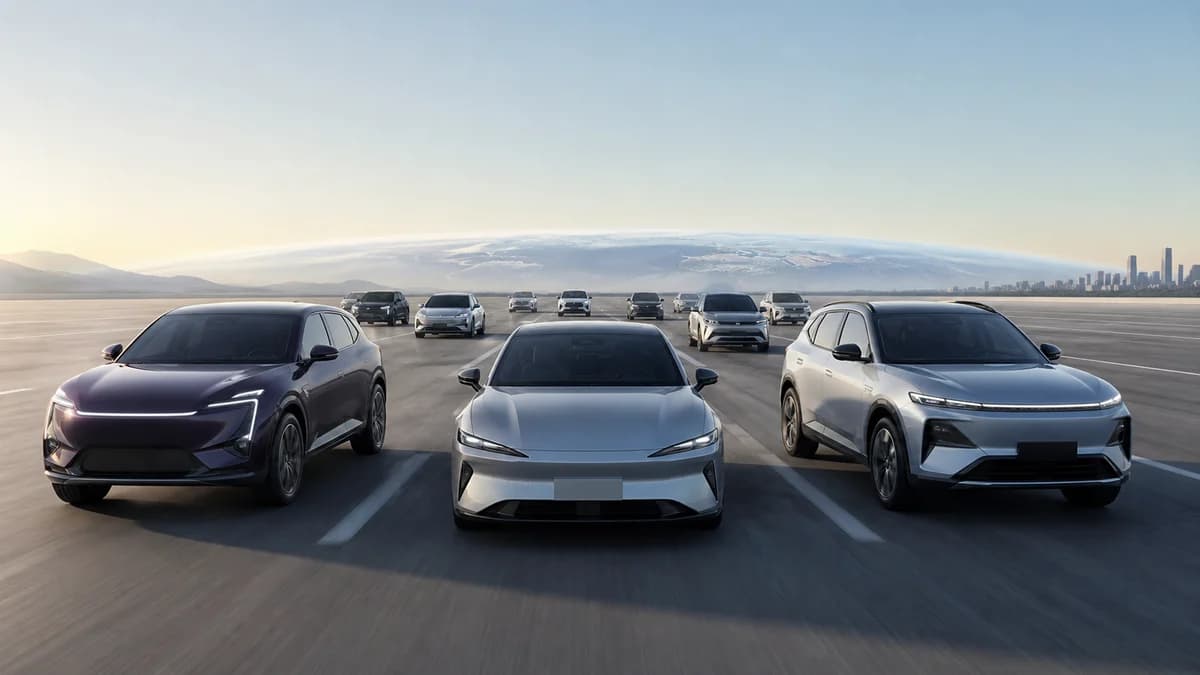
Three Chinese automotive groups ranked inside the global top ten by market share in the first half of 2026.
Data cited by CarNewsChina and TechNode places BYD sixth at 4.8 percent, Geely Group seventh at 4.6 percent and Chery tied with Ford for ninth at 4.1 percent.
Toyota remained first.
The more important shift is further down the table.
Chinese brands are no longer competing only for electric-vehicle relevance. They are becoming some of the world's largest car companies.
What you need to know
- BYD ranked sixth globally in H1 2026.
- Geely Group ranked seventh.
- Chery tied Ford for ninth.
- Geely's group includes brands such as Volvo, Polestar and Zeekr.
- Chery's export growth is a major part of its expansion.
- Chinese automakers still face tariffs, politics and domestic price pressure.
BYD's rise is not only about batteries
BYD grew from a battery company into a vertically integrated automaker.
It controls or develops major parts of battery cells, vehicle electronics, electric motors, power semiconductors, software and manufacturing.
That integration can reduce cost and shorten product-development cycles.
BYD also sells both battery-electric and plug-in hybrid vehicles.
That lets it expand into markets where charging infrastructure is still developing.
The company can meet a buyer where the infrastructure is rather than waiting for the infrastructure to catch up.
Geely is a portfolio, not one badge
Geely Holding's strength looks different.
The group includes or controls a broad collection of brands and partnerships.
Depending on market and corporate structure, consumers may interact with Geely through Geely Auto, Zeekr, Volvo, Polestar, Lynk & Co or Smart.
That creates access to technology, distribution and brand positioning across price levels.
Geely can learn in China and deploy internationally through brands customers already recognise.
It is one reason global rankings need to be understood at group level rather than badge level.
Chery's export machine
Chery has built one of China's strongest export businesses.
It competes aggressively in markets where Japanese, Korean and European brands historically dominated.
Its growth is helped by competitive pricing, SUV-heavy lineups, dealer expansion, local assembly, multiple brands and flexible powertrains.
The company has been especially willing to enter markets that larger Western manufacturers treat as secondary.
That matters in Africa, Latin America, the Middle East and parts of Europe.
Global scale often begins by taking overlooked markets seriously.
What happened to Western dominance?
Western automakers did not suddenly become bad at making cars.
The competitive environment changed.
Electric vehicles require strengths in batteries, software, electronics, supply chains and rapid iteration.
Chinese manufacturers built scale inside the world's largest EV market.
Domestic competition became brutal. Companies launched products faster and fought aggressively on price.
That pressure created firms capable of exporting strong products at prices that surprise established competitors.
China's domestic price war may be painful for manufacturers. Internationally, it acts like a training programme.
Why this matters in Africa
African buyers are increasingly exposed to Chinese vehicle brands.
The important questions are no longer: "Is a Chinese car good enough?"
They are: Is there local service? Are parts available? Does the battery have support? What is resale value? Is software maintained? Is financing available? Is the charging standard compatible?
Scale can improve answers to these questions.
A global top-ten company has more resources to build distribution and support.
It can still execute badly in a specific country.
Brand size should increase expectations, not lower scrutiny.
Tariffs will not stop the trend by themselves
The EU and other markets have introduced trade measures around Chinese EVs.
Tariffs can slow expansion. They also encourage local manufacturing.
Chinese firms are investing in factories and assembly outside China.
That can turn a trade barrier into a localisation strategy.
The long-term competition will therefore be about factories, jobs, suppliers, batteries, software, dealerships and finance, not simply imported cars.
Their scale also changes the battery race, including CATL and BYD's 2027 solid-state trial timeline.
The tecMAMBO take
BYD, Geely and Chery entering the global top ten changes the vocabulary.
Calling Chinese automakers "emerging competitors" is becoming inaccurate.
They are incumbents in the making.
The next test is global ownership quality.
Selling millions of cars is one achievement. Supporting them across continents for ten years is another.
FAQ
Where did BYD rank?
BYD ranked sixth by the cited H1 2026 global market-share data.
Where did Geely rank?
Geely Group ranked seventh.
What about Chery?
Chery tied Ford for ninth at 4.1 percent.
Is Toyota still number one?
Yes, Toyota remained the global leader in the cited ranking.
Why are Chinese automakers growing so quickly?
Large domestic scale, battery expertise, rapid product cycles, competitive pricing and export expansion all contribute.
Sources
Share this story
Enjoyed this? Share it with someone who'd appreciate it.
Ask MAMBO
Have a plain-English question about this topic? Send it in and we may answer it in a future guide.
Ask a questionRelated reading
China's BYD battery blogger dispute is becoming a test of who gets to challenge product claims
China's CAC named tech blogger Cai Shen Dao in an enforcement case over allegedly false product evaluations tied to BYD Blade Battery 2.0 testing.
Smart #2 is returning to the tiny-car idea that made Smart interesting
China's MIIT filing reveals the production-bound Smart #2 at about 2.75 metres long with a 60 kW motor and CATL LFP cells.
CATL and BYD want solid-state battery trials in 2027. Your next EV probably will not have one
CATL and BYD are targeting small-scale solid-state battery production in 2027, but cost, yield and durability still separate trials from mass-market EVs.