

A Zeekr 7X caught fire near a charger. The earlier crash may matter more than the charger
A Zeekr 7X was involved in a fire incident on 9 August in Ningbo, China. No injuries were reported.
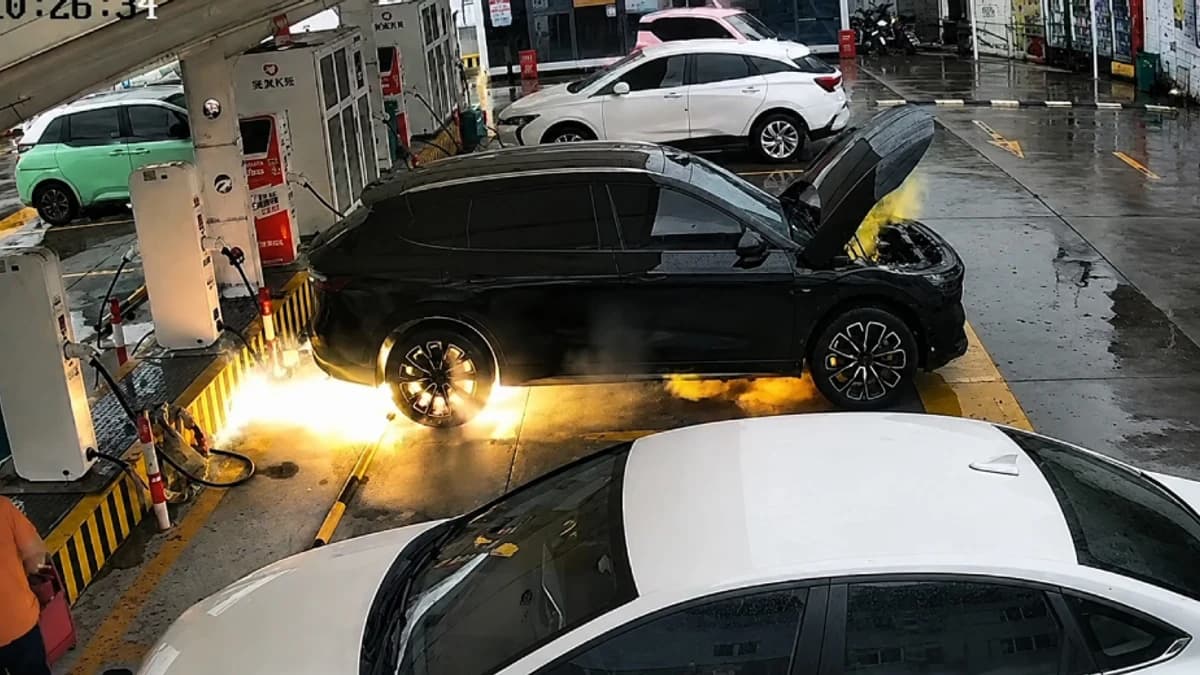
A Zeekr 7X was involved in a fire incident on 9 August in Ningbo, China.
No injuries were reported.
Zeekr says the vehicle had previously been involved in a severe collision and had not undergone inspection or repair at an authorised Zeekr service centre.
The final cause remained under investigation when this article was prepared.
That distinction matters.
A video of an electric vehicle burning near a charger can spread around the world before anyone knows whether the charger, battery, crash damage or another system caused the event.
What you need to know
- The incident occurred on 9 August 2026 in Ningbo.
- No injuries were reported.
- Zeekr dispatched a team and is cooperating with authorities.
- The company says the vehicle had a history of severe collision damage.
- The final cause has not been established.
- Proximity to a charger does not prove the charger caused the fire.
Why damaged batteries require special attention
An EV battery pack contains many cells protected inside a strong enclosure.
A severe crash can damage cells, cooling, wiring, seals, structural members and high-voltage isolation.
Damage may be visible immediately. It can also be hidden.
A battery can develop internal defects that become dangerous later.
That is why manufacturers specify inspection procedures after severe impact.
A car that still drives is not automatically safe.
Thermal runaway explained
Lithium-ion cells can enter thermal runaway when internal temperature rises uncontrollably.
Possible triggers include physical damage, manufacturing defect, overheating, electrical short or improper repair.
Once one cell fails, heat can spread to neighbouring cells.
Modern packs include barriers, cooling and control systems designed to slow propagation.
EV fires can be difficult to manage because a battery stores a large amount of energy and may reignite.
This makes accurate investigation essential.
The charger may be innocent
Images of a burning EV at a charging site naturally create a charging-fire narrative.
Investigators need evidence.
Questions include whether the vehicle was connected, its state of charge, whether the charger logged a fault, where ignition began, whether the pack was damaged earlier, whether repairs were attempted and whether the battery management system reported warnings.
Location is not causation.
A petrol car can catch fire at a fuel station for reasons unrelated to the pump.
The same logic applies to EVs.
Why previous collision history matters
Zeekr's statement says the 7X had experienced a severe collision.
If confirmed, that history changes the investigation.
Owners of damaged EVs should take high-voltage inspection seriously.
A proper post-crash check may include pack integrity, isolation resistance, cooling, connectors, fault codes and underbody deformation.
Independent repair shops also need EV-specific training.
Traditional body repair is not enough when structural damage can affect a high-voltage battery.
Avoiding anti-EV and pro-EV propaganda
Battery fires are emotionally powerful.
Critics use them to argue electric vehicles are inherently unsafe.
Defenders sometimes dismiss every incident as statistically irrelevant.
Both reactions are lazy.
The useful questions are how often incidents occur, what causes them, how difficult they are to extinguish, what warning systems exist and how damaged vehicles should be handled.
Safety improves when failures are studied rather than recruited into culture wars.
What African EV markets should learn
As EV imports increase, local repair capacity needs to grow.
African markets need battery diagnostics, post-crash inspection standards, firefighter training, towing procedures, battery rules, insurer expertise and technician certification.
Imported EVs can outpace local service knowledge.
That creates risk even when the original vehicle is well engineered.
Electrification requires an ecosystem of safety, not only chargers.
Battery safety must grow alongside infrastructure, including East Africa's expanding charging and battery-swap networks.
The tecMAMBO take
The Zeekr 7X incident should be investigated rigorously.
It should not be converted into a conclusion before investigators finish.
The previous severe collision is a significant fact.
If battery damage contributed, the lesson may be about post-crash inspection rather than .
The fastest way to learn nothing from an EV fire is to decide what caused it from a short video.
FAQ
Was anyone injured?
No injuries were reported.
Did the charger cause the fire?
That has not been established.
What did Zeekr say?
Zeekr said the vehicle had previously suffered a severe collision and had not been inspected or repaired at an authorised service centre.
Can EV batteries fail after a crash?
Yes. Hidden damage can affect cells, wiring, cooling or isolation.
What should owners do after a severe impact?
Follow the manufacturer's high-voltage inspection procedure even if the vehicle appears driveable.
Sources
Share this story
Enjoyed this? Share it with someone who'd appreciate it.
Ask MAMBO
Have a plain-English question about this topic? Send it in and we may answer it in a future guide.
Ask a questionRelated reading
CATL and BYD want solid-state battery trials in 2027. Your next EV probably will not have one
CATL and BYD are targeting small-scale solid-state battery production in 2027, but cost, yield and durability still separate trials from mass-market EVs.
NIO's 4,000th battery swap station shows what charging networks still cannot do
NIO's new station can hold more batteries and complete a swap in under two minutes, but the model remains expensive and difficult to standardise.

Standard Bank and UnionPay just widened Africa's online payment rails across nine markets
Standard Bank and UnionPay have expanded online payment acceptance across nine African markets, connecting nearly 900 merchants to UnionPay cardholders.