

India wants to lock in electronics manufacturing until 2041, and Apple is a major reason why
India is considering extending tax exemptions for foreign electronics suppliers from 2031 to 2041. The proposal is designed to give companies supplying equipment to local manufacturers a longer period of tax certainty.
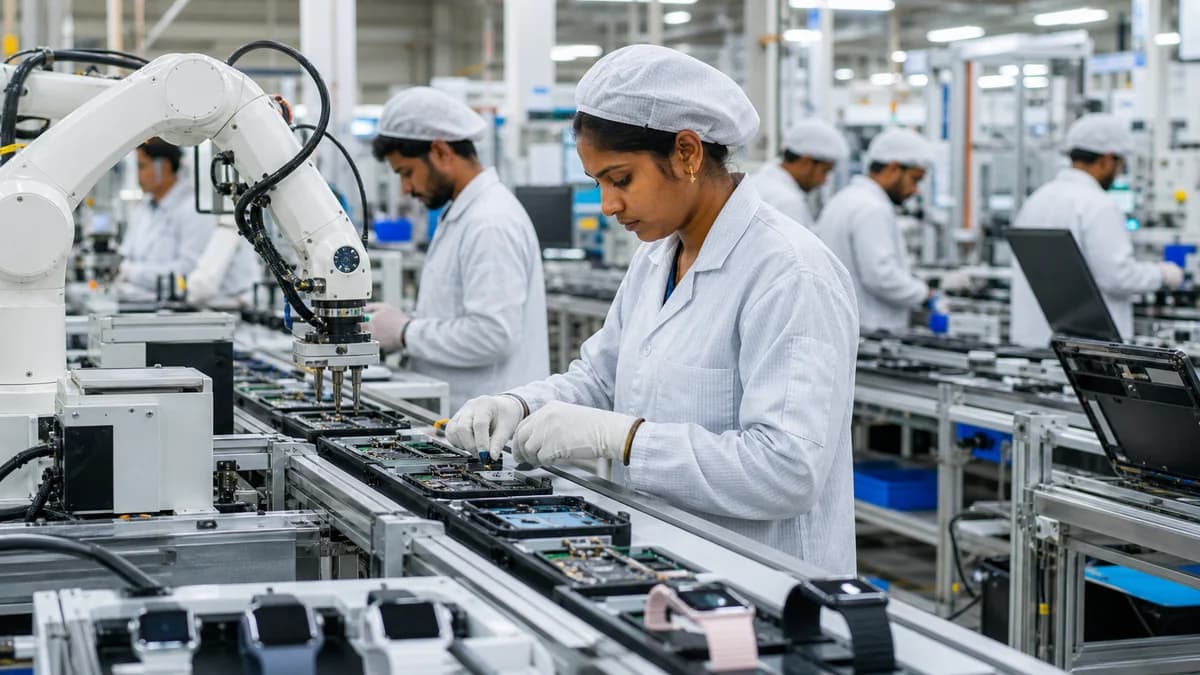
India is considering extending tax exemptions for foreign electronics suppliers from 2031 to 2041.
The proposal is designed to give companies supplying equipment to local manufacturers a longer period of tax certainty.
It covers production linked to devices including phones, laptops, tablets, wearables and servers.
Apple's supply chain is one of the clearest examples of why the policy matters.
India is no longer simply trying to attract final assembly. It wants the surrounding manufacturing ecosystem to stay.
What you need to know
- India is proposing a longer tax-exemption window for qualifying foreign suppliers.
- The extension would run to 2041.
- The policy supports electronics manufacturing equipment and supply chains.
- Apple, Foxconn and Tata have expanded iPhone production in India.
- Smartphones have become one of India's most important manufactured exports.
- India still depends heavily on imported components and equipment.
Assembly is only the first stage
A country can assemble phones without owning much of the value chain.
Components may still come from elsewhere.
High-value steps include chip packaging, displays, cameras, batteries, precision machining, manufacturing equipment, engineering and logistics.
India's long-term goal is to move deeper into these layers.
That requires suppliers to invest locally.
Suppliers hesitate when tax treatment is uncertain.
A longer exemption period reduces one part of that risk.
Why Apple matters
Apple's supply chain has enormous scale.
When iPhone assembly moves, suppliers pay attention.
Foxconn and Tata have expanded production in India as Apple reduces its dependence on China.
The shift is not complete.
China retains unmatched supplier density, engineering expertise and infrastructure.
India does not need to reproduce China overnight. It needs to become reliable enough that global companies design future supply chains around both countries.
That changes bargaining power.
India's export story is becoming real
Smartphones have become a major Indian export category.
Production incentives helped attract global brands and expand domestic capacity.
The success creates a policy challenge.
What happens when the original incentives expire?
Manufacturers do not want a business model that depends on permanent subsidy. Governments do not want factories to leave when incentives end.
The next stage needs productivity, infrastructure and supplier depth.
A tax break can attract a factory. Efficient ports and trained engineers keep it there.
The China comparison is unavoidable
China built an electronics ecosystem over decades.
Factories sit close to component suppliers, tooling companies, logistics hubs, engineers, ports and chemical suppliers.
This density reduces time.
A design change can move through the supply chain quickly.
India's challenge is not only labour cost. It is building the same speed of coordination.
That requires cities, transport, power, customs and education.
Manufacturing competitiveness is an infrastructure product.
Why wearables and laptops matter
Smartphones are a gateway.
The same ecosystem can support earbuds, watches, laptops, tablets and servers.
Diversification makes factories less dependent on one product cycle.
It also creates opportunities for domestic companies to enter component supply.
India wants manufacturing to become a cluster.
Clusters survive better than isolated factories.
What this means for Africa
African countries often discuss local electronics assembly.
India offers both inspiration and warning.
Successful manufacturing requires more than low wages.
Countries need stable power, ports, customs efficiency, supplier ecosystems, skills, industrial land, predictable tax, export access and long-term policy.
A single assembly plant can create jobs.
An ecosystem creates an industry.
African industrial policy should aim for the second.
The geopolitical layer
US-China tension has encouraged companies to diversify.
India benefits from this China-plus-one strategy.
That advantage can disappear if geopolitics changes.
India therefore needs to become competitive for reasons beyond risk avoidance.
The strongest manufacturing location is chosen because it works, not because another location became politically uncomfortable.
Supply-chain depth also affects consumer pricing, which is why Qualcomm's rising chip prices matter to phone buyers.
The tecMAMBO take
India's proposed tax extension is less exciting than a new smartphone.
It may be more important.
The country is trying to turn a decade of assembly growth into a durable industrial ecosystem.
Apple is helping create momentum.
India's success will be measured by how many suppliers eventually choose the country even when no government asks them to.
FAQ
What is India proposing?
A longer tax-exemption period for qualifying foreign suppliers supporting electronics manufacturing.
How long would it last?
The proposal would extend the window to 2041.
Why does Apple matter?
Apple has expanded iPhone production through suppliers including Foxconn and Tata, attracting broader supply-chain investment.
Does India make all iPhone components?
No. Many components and production technologies still come from global suppliers.
Why is this relevant to Africa?
It shows that successful electronics manufacturing depends on a full ecosystem, not assembly labour alone.
Sources
Share this story
Enjoyed this? Share it with someone who'd appreciate it.
Ask MAMBO
Have a plain-English question about this topic? Send it in and we may answer it in a future guide.
Ask a questionRelated reading

Apple's 2026 iPhone plan could leave budget buyers waiting until 2027
A split launch would turn Apple's biggest 2026 phone event into a premium-only season and push value-conscious buyers toward older iPhones or Android.

iPhone Duo vs Samsung Galaxy Z Fold8: What Apple Actually Got Right, and What It Didn't
This is analysis, not neutral reporting.

The iPhone Ultra shortage is also a marketing plan
Analyst estimates say Apple's first foldable iPhone could be scarce at launch. That may be a manufacturing constraint, but the sold-out effect still sells the product.