

Spotify will label AI Personas and keep them out of recommendations by default
Spotify is separating artist identity from production method, letting synthetic performers exist while removing them from default recommendation surfaces unless listeners actively opt in.
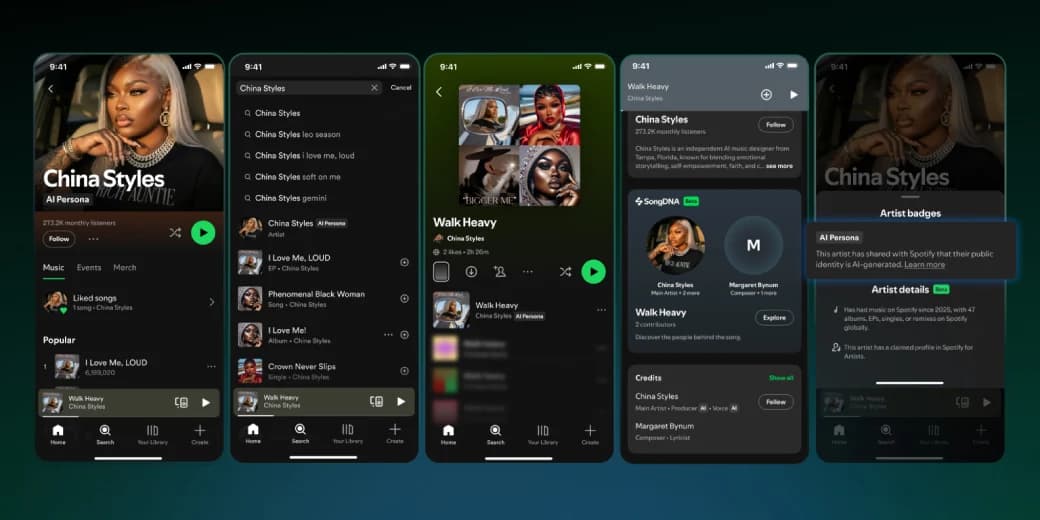
Spotify is drawing a new line in the AI music debate.
Starting in mid-September, listeners will begin seeing an AI Persona badge on selected artist profiles whose public identity represents an AI-generated person rather than a real human artist.
The badge will appear on artist profiles, in Search and beside tracks in playlists.
Spotify is also making a stronger product decision.
Music from AI Persona profiles will be excluded by default from Spotify's editorial and algorithmic recommendations unless the listener has actively shown interest, such as by following the profile or saving its music.
That moves the feature beyond transparency.
It changes distribution.
The badge is about identity, not how a song was made
This is the most important distinction.
A human artist can use AI tools while writing, producing, mixing or creating artwork without becoming an AI Persona.
Spotify says the badge applies to the public identity of the artist profile.
The question is:
Does this profile represent a real person?
That is different from:
Was AI used somewhere in the creative process?
Spotify has separate transparency systems for creation details, including AI Credits and SongDNA.
That separation is sensible.
Modern music production can use AI in dozens of ways.
Reducing every use of an AI tool to "AI artist" would tell listeners very little.
Artists can disclose themselves, but Spotify will also review profiles
Spotify for Artists allows a profile to self-identify as an AI Persona.
The company says it will not rely entirely on voluntary disclosure.
Spotify will also review profiles whose names, images and public presentation appear to represent photorealistic synthetic identities.
It plans to focus initially on profiles that meet audience thresholds so the labels cover accounts listeners are most likely to encounter.
If Spotify applies the badge after review, the profile can be notified and has an appeal path.
That matters.
Identity classification can be wrong.
A platform should not quietly label a real artist synthetic without a meaningful way to challenge the decision.
Recommendation behaviour is the bigger policy
The streaming problem is not simply that AI music exists.
It is that recommendation systems can give synthetic content enormous scale.
Generating music is becoming cheaper.
An operator can potentially produce large catalogues and optimise them for passive listening.
Recommendation algorithms can then become a distribution engine for volume rather than audience demand.
Spotify's decision to keep AI Personas out of default recommendation surfaces is an attempt to preserve scarce algorithmic attention for human artists building careers.
That is a significant philosophical choice.
Spotify is not banning synthetic artists.
It is saying they do not automatically receive the same discovery machinery.
Is that unfair to AI-native art?
Supporters of synthetic performers may argue that if listeners enjoy the music, the platform should treat it neutrally.
Spotify's policy separates two questions.
Can an AI Persona exist on the service?
Should Spotify recommend it automatically?
The answer is yes to the first and, by default, no to the second.
Users can still seek out or follow AI Personas.
That creates a middle ground between prohibition and algorithmic neutrality.
The policy will still be difficult around fictional characters and virtual performers.
Music had synthetic and fictional identities long before generative AI.
The boundary between creative character and deceptive human impersonation will need careful handling.
The badge could become a model for the wider internet
Platforms increasingly need to answer a basic question:
Who is speaking?
A profile picture and biography are no longer reliable evidence that a person exists.
Spotify's approach creates several layers of context:
- Human identity verification
- AI Persona identity
- Production-method disclosures
Other platforms may eventually need comparable signals for influencers, customer-service agents, authors and virtual celebrities.
The internet spent years learning to authenticate accounts.
Generative AI is forcing platforms to authenticate existence.
What happens when the AI Persona is genuinely popular?
Suppose an AI Persona creates music people genuinely love.
Users can still search for it, follow it and save it.
If enough people do that, the audience exists without the default recommendation engine doing most of the work.
That creates an interesting test of active demand.
It also gives Spotify a way to distinguish between synthetic supply created cheaply at scale and a synthetic performer that has actually built fandom.
Why African artists should care
Streaming discovery is particularly important for musicians whose domestic recorded-music markets may not provide large revenues.
If low-cost synthetic content floods recommendation surfaces, human artists from smaller markets can lose visibility.
Spotify's policy could protect scarce discovery space.
There is another side.
AI tools can help independent African musicians create with fewer resources.
A human artist should not be penalised simply because those tools were part of production.
Spotify's distinction between identity and method is therefore useful.
The tecMAMBO take
Spotify is taking a more nuanced position than "AI music good" or "AI music bad."
The company is separating three questions:
Who is the artist?
How was the music created?
Should the algorithm recommend it automatically?
Those are different questions.
The AI Persona badge gives the listener context.
The recommendation restriction is more consequential because it decides who receives algorithmic attention.
In an age of extremely cheap content generation, attention may become the most important royalty of all.
Sources
Share this story
Enjoyed this? Share it with someone who'd appreciate it.
Ask MAMBO
Have a plain-English question about this topic? Send it in and we may answer it in a future guide.
Ask a questionRelated reading
Spotify wants fans to remix copyrighted songs legally, and Kobalt just joined the experiment
Spotify is trying to turn a behaviour already happening across the internet into a licensed creation product where songwriters remain credited and compensated.
Apple TV just came to Kenya for the first time, bundled into a $0.99 cloud storage plan
Apple TV is available for the first time ever in Kenya as of this month, bundled at no extra cost into every paid iCloud+ subscription, including the entry-level 50GB plan, which stays at $0.99 a month, roughly KES 128.

Kenya's cyber cafe rules do not require browsing history, but the logging debate is not over
The CA has clarified that cyber cafes must keep basic session records, not private browsing histories. The remaining question is whether the identification framework is proportionate in 2026.