

WhatsApp Plus is official: what KSh 119 gets Kenyan users and what stays free
WhatsApp Plus is Meta's optional paid tier for personal WhatsApp Messenger. Kenyan rollout reporting has shown KSh 119 a month, while ordinary messages, calls and encryption remain free.
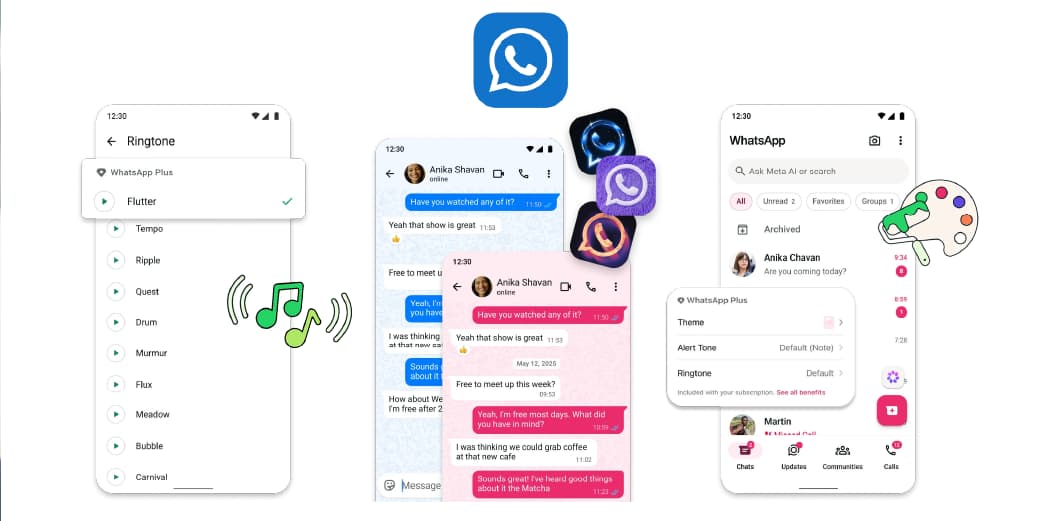
WhatsApp now has an official paid tier for personal users.
It is called WhatsApp Plus, and it adds customisation and organisation features to the standard WhatsApp Messenger experience without placing messaging, calls, encryption or ordinary chat functionality behind a subscription.
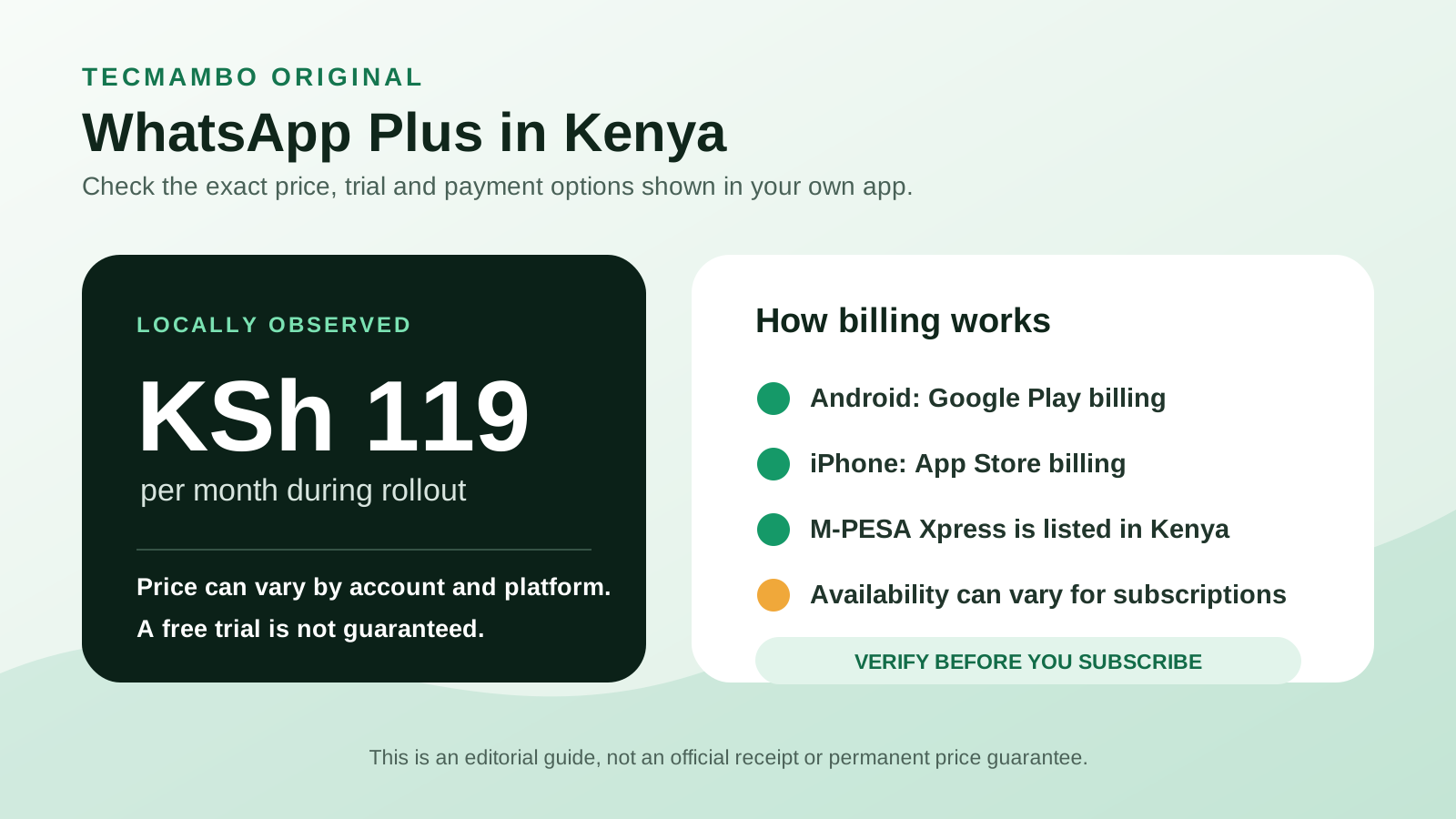
In Kenya, local rollout reporting has shown a price of KSh 119 per month, with some users also seeing a one-month free trial. The United States launch price has been reported at $2.99 per month.
There is an important qualification.
WhatsApp's official product page confirms the Plus subscription and its feature set, but it does not publish one permanent country-by-country price table. Prices, trial offers and store billing can vary by market, account and platform.
Kenyan users should therefore treat KSh 119 as the current locally observed price and confirm the amount shown inside their own WhatsApp subscription screen before paying.
What is not ambiguous is the direction.
For years, WhatsApp's product philosophy centred on making the basic messaging experience simple and widely accessible. WhatsApp Plus introduces a new idea: the core app remains free, but users who want more control over how their inbox looks and behaves can pay for it.
That puts WhatsApp in the same broad subscription conversation as Telegram Premium, Snapchat+ and the wider range of paid extras now appearing across major social apps.
The question is whether the extras are useful enough to justify another monthly subscription.
For a casual WhatsApp user, probably not.
For someone who effectively runs work, family, church, clients, neighbourhood groups and side hustles from the same inbox, the answer becomes more interesting.
WhatsApp Plus is optional, and normal WhatsApp is still free
The most important thing to understand is that WhatsApp Plus does not replace normal WhatsApp.
WhatsApp's own product page describes Plus as an optional subscription.
The free version continues to provide the features most people associate with the service, including personal messaging, group chats, voice calls, video calls, , Status, Communities and standard personalisation.
WhatsApp's Help Center also continues to state that the company does not charge users for sending messages and media or making voice and video calls.
Plus is therefore not a messaging paywall.
It is a convenience and personalisation tier.
That distinction matters because a subscription on WhatsApp can sound much more dramatic than the product actually is.
Meta is not telling billions of users to pay before they can text their family. It is asking a smaller group of users whether cosmetic control and better inbox organisation are worth a recurring fee.
WhatsApp was already being monetised before Plus
It would be inaccurate to describe WhatsApp Plus as the first time Meta has tried to make money from the WhatsApp ecosystem.
WhatsApp introduced monetisation around the Updates tab in 2025, including promoted channels, channel subscriptions and advertising in Status. Those products were deliberately kept away from personal chats.
WhatsApp Plus is different because it introduces a direct optional subscription for users of the personal WhatsApp Messenger application.
That makes it an important shift.
The monetisation model is no longer only businesses paying, advertisers paying, or users subscribing to individual channels. An ordinary WhatsApp user can now also pay Meta directly for additional personal features.
That does not make the free service disappear. It widens the number of places where Meta can generate recurring revenue from WhatsApp.
What do you get with WhatsApp Plus?
WhatsApp's official Plus page currently highlights five main categories of benefits:
- More pinned chats
- Custom app themes and icons
- Exclusive ringtones
- Special-effect stickers
- Custom alerts, ringtones and themes for chat lists
The practical value varies considerably.
The feature most likely to change day-to-day use is not a colour theme. It is the expanded pin limit.
Up to 20 pinned chats is the feature power users may actually pay for
The standard WhatsApp app allows users to pin up to three chats at the top of the chat list.
WhatsApp Plus expands that limit to 20.
This sounds small until you look at how WhatsApp is used in Kenya.
One person's inbox can contain:
- Spouse and immediate family
- Extended family group
- Work team
- Client conversations
- Church group
- Chama
- Estate security group
- School or parents group
- Delivery contacts
- Landlord
- Business suppliers
- Side-hustle customers
Three pinned chats can become restrictive very quickly.
Twenty changes the way the top of the inbox can function.
Instead of searching every time an important thread disappears below a wave of active groups, the user can keep the conversations that matter most permanently visible.
For someone whose WhatsApp is effectively a lightweight operating system for daily life, that can remove real friction.
For someone who talks mainly to five friends and one family group, it is much harder to justify paying for.
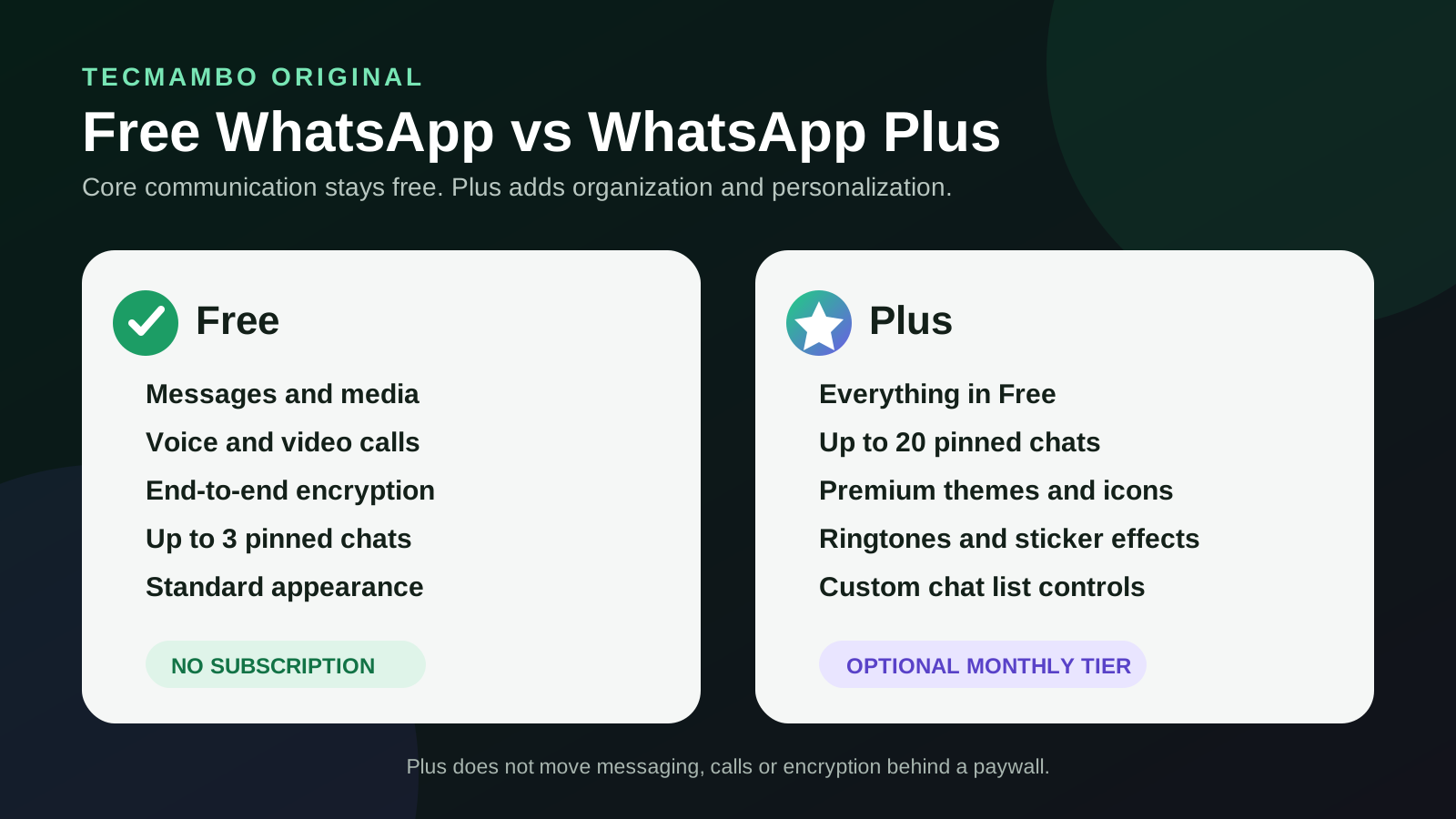
Free WhatsApp vs WhatsApp Plus
| Feature | Free WhatsApp | WhatsApp Plus |
|---|---|---|
| Personal messages | Included | Included |
| Voice and video calls | Included | Included |
| End-to-end encryption | Included | Included |
| Pinned chats | Up to 3 | Up to 20 |
| Standard app appearance | Included | Included |
| Premium app themes | No | Yes |
| Alternate app icons | No | Yes |
| Exclusive ringtones | No | Yes |
| Special-effect stickers | No | Yes |
| Custom chat list controls | Standard controls | Expanded Plus controls |
| Subscription fee | None | Market-dependent monthly fee |
What about the 18 themes and 14 app icons?
Early and launch-period reporting has shown 18 theme colours and 14 alternate app icons in WhatsApp Plus.
Those counts have appeared consistently in coverage of the rollout.
WhatsApp's own public product page currently confirms exclusive app icons and colour customisation but does not display a fixed count on the main marketing page.
Those figures are best treated as the current observed feature set rather than a promise that the numbers can never change.
Meta can add, remove or rotate premium designs over time.
The strategic point is more durable.
WhatsApp is allowing users to change the visual identity of the application in ways that go beyond ordinary light mode, dark mode and chat wallpaper settings.
For a company whose green interface is one of the most recognisable pieces of mobile software in the world, that is a surprisingly big design concession.
Custom themes turn WhatsApp into something less visually rigid
WhatsApp's free version already supports chat themes and wallpapers.
Plus goes further by allowing subscribers to customise the wider app appearance using exclusive colour treatments.
Launch reporting has shown colours including blue, purple, navy, coral and other alternatives to the traditional WhatsApp green.
For some users, this will feel superficial.
It is superficial.
That does not make it pointless.
People spend hours inside messaging apps every week. The visual environment becomes part of the device experience.
Apple learned this through home-screen customisation. Telegram has offered extensive appearance controls for years. Android users have long used launchers, icon packs and themes to make phones feel personal.
WhatsApp is now charging for a curated version of that same instinct.
Custom icons are mostly about the home screen
Plus subscribers can choose from exclusive WhatsApp app icon designs.
This has little functional value.
It matters to people who care about how their home screen looks.
That is exactly why it fits a subscription.
Meta can keep basic usability free while placing optional aesthetic extras in the paid tier.
The danger is feature creep.
A good freemium model puts nice-to-have extras behind the subscription. A bad one slowly moves normal usability improvements behind the paywall.
Twenty pinned chats sits closer to that boundary because it solves an organisational problem rather than merely changing a colour.
WhatsApp will need to be careful that Plus does not become a place where ordinary quality-of-life improvements are deliberately withheld from free users.
Premium ringtones and special-effect stickers
WhatsApp also includes exclusive ringtones and premium stickers in Plus.
The official product page says subscribers can set unique ringtones for important contacts. Special-effect stickers can produce full-screen visual effects during conversations.
These features are more playful than essential.
They can still become effective subscription-retention tools.
A custom ringtone is not worth KSh 119 by itself. Neither is an app icon. Neither is a sticker.
But a user who actively uses pins, themes, icons, ringtones and list customisation begins to feel they are giving up several things at once if they unsubscribe.
That is normal subscription product design.
Chat list customisation may be more useful than it sounds
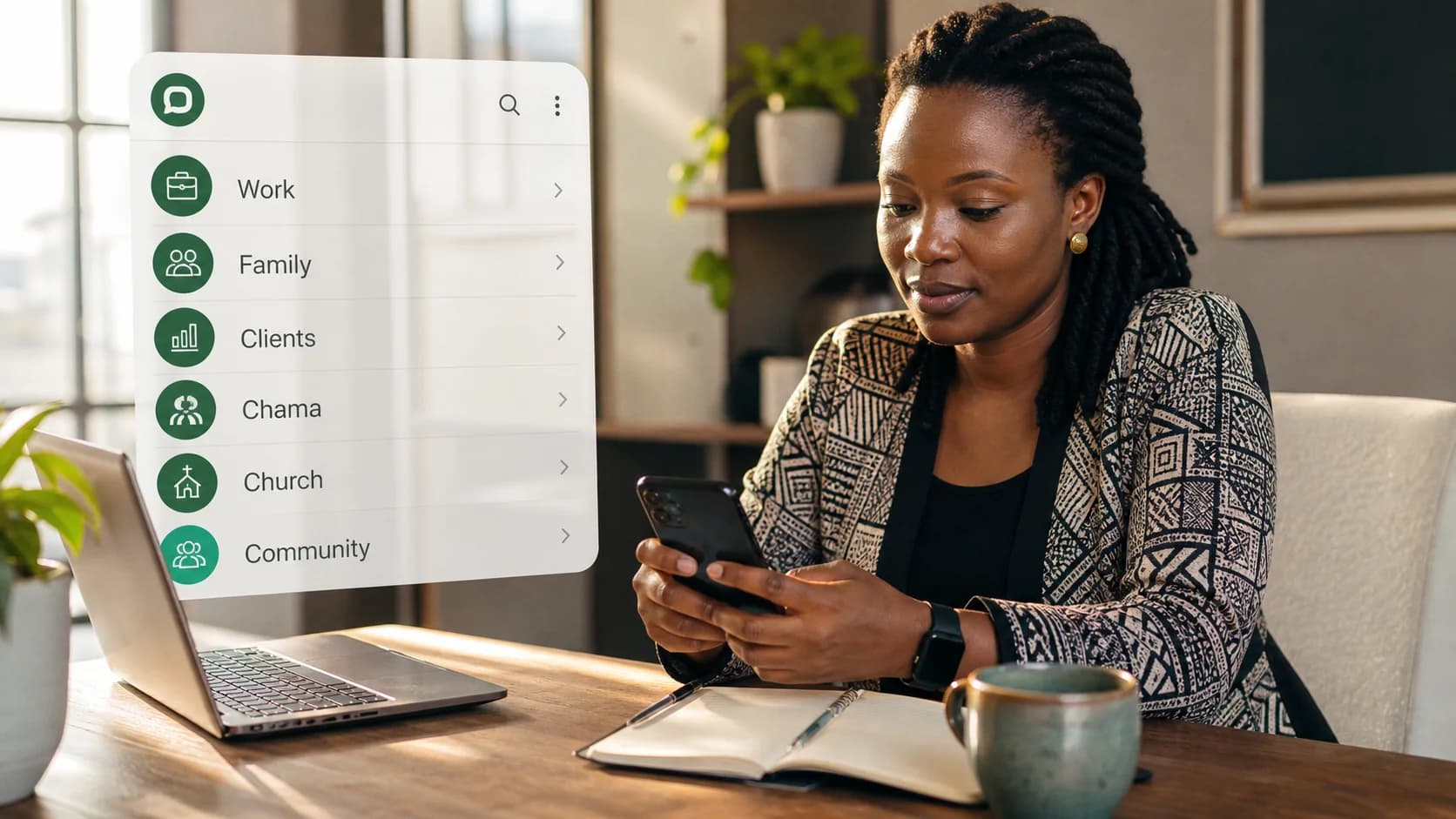
WhatsApp has been expanding Lists to help people separate conversations into categories.
Plus lets subscribers set custom alerts, ringtones and themes for individual chat lists.
That could be useful for someone who keeps separate lists for:
- Work
- Family
- Clients
- Groups
- Priority contacts
Instead of every part of the inbox behaving identically, lists can carry their own visual or notification identity.
A business owner could make work conversations visually distinct. A user could assign a stronger alert pattern to a priority list.
This supports a bigger idea.
WhatsApp is evolving from one chronological message list into a more configurable communication dashboard.
That wider reinvention also includes WhatsApp usernames, which can let people connect without sharing a phone number.
The Kenyan price: KSh 119, with a pricing caveat
Kenyan technology reporting has documented WhatsApp Plus at KSh 119 per month during the local rollout.
Some users have also been shown a one-month free trial.
That makes the subscription relatively inexpensive by international app-subscription standards.
KSh 119 is roughly the price of a small everyday convenience rather than a major entertainment service.
The psychology matters.
A KSh 500 subscription invites a decision. KSh 119 is designed to make many users think, "Why not?"
That does not mean everybody should subscribe.
Recurring small payments accumulate precisely because they feel too small to evaluate individually.
A user paying for , music, streaming, an AI service, a and several premium social features can end up with a significant monthly subscription bill.
The correct question is therefore not whether KSh 119 is objectively cheap.
It is whether WhatsApp Plus solves enough of your daily friction to deserve another recurring charge.
Important pricing note
WhatsApp's official Plus product and support pages do not currently publish one permanent global country-price table.
The final amount can vary by country, platform, app-store pricing, taxes, promotional offers and account eligibility.
Users should confirm the exact price and renewal terms shown inside WhatsApp before subscribing.
Can Kenyan Android users pay using ?
Google Play officially lists M-PESA Xpress among accepted payment methods in Kenya.
That means eligible Android users can potentially pay for supported Google Play purchases and subscriptions through the local billing options available to their account.
There are caveats.
Google notes that some carrier billing arrangements may not work for subscriptions, prepaid numbers may have restrictions, and available methods can vary by device and account.
So the accurate advice is:
M-PESA Xpress is an accepted Google Play payment method in Kenya, but users should check whether it appears as an available payment option for their specific WhatsApp Plus subscription.
Do not assume every Kenyan Android user can automatically renew WhatsApp Plus through M-PESA.
On iPhone, billing follows Apple's App Store subscription and payment system.
The name WhatsApp Plus is deeply ironic for Android users
For longtime Android users, the branding comes with baggage.
"WhatsApp Plus" existed for years as a name associated with unofficial modified WhatsApp applications.
Other well-known mods include GB WhatsApp and FM WhatsApp.
These applications became popular partly because they offered features the official app did not, including deeper themes and behavioural customisation.
The problem is that unofficial WhatsApp apps are not supported by WhatsApp.
WhatsApp's own Help Center explicitly lists apps such as GB WhatsApp among unofficial third-party versions and says it cannot validate their security and privacy practices.
Using unsupported versions can also lead to account restrictions.
For a separate security feature built into the supported app, read how WhatsApp's Scam Alert checks suspicious messages on the device.
That gives Meta's choice of the WhatsApp Plus name an almost comic quality.
The official app is now selling a safer version of some of the customisation demand that unofficial mods helped reveal.
Is Meta trying to kill GB WhatsApp?
Meta has not publicly said that WhatsApp Plus was launched to reclaim GB WhatsApp users.
It is therefore not a confirmed strategy.
It is, however, a reasonable product inference.
Unofficial mods demonstrated demand for more control over WhatsApp's appearance and behaviour.
Official Plus now provides custom themes, alternate icons, more pinned chats, special stickers, custom ringtones and better list controls.
These are the kinds of quality-of-life features that made modified clients attractive to some users.
The difference is trust.
Official WhatsApp Plus operates inside the supported WhatsApp application.
A user does not need to download an from an unknown website or use an application WhatsApp explicitly warns it cannot validate.
That is a meaningful advantage.
What WhatsApp Plus does not give you
Users familiar with old WhatsApp mods should not assume the official subscription includes every controversial feature those apps offered.
WhatsApp Plus does not create a second set of privacy rules for subscribers.
It does not officially promise features such as secretly bypassing another person's privacy choices, circumventing WhatsApp security, breaking end-to-end encryption or removing another user's control over their own messages.
That is good.
A paid subscription should not monetise privacy asymmetry.
Meta is keeping Plus focused on organisation and personalisation rather than selling surveillance-like behaviour.
WhatsApp Plus is currently for personal WhatsApp Messenger
WhatsApp's Help Center says Plus is currently available for WhatsApp Messenger on iPhone and Android.
That is separate from the WhatsApp Business application.
This distinction matters in Kenya because many small businesses use WhatsApp Business as their primary customer-service tool.
A shop, consultant or online seller should not assume that subscribing to WhatsApp Plus is a business upgrade.
WhatsApp Business has its own tools and separate monetisation products.
Plus is aimed at the personal Messenger product.
That creates an interesting edge case.
A Kenyan entrepreneur using ordinary personal WhatsApp for most client communication may find 20 pinned chats extremely useful. A more formally configured WhatsApp Business user should not assume Plus is available in the same way.
Is WhatsApp Plus good value for Kenyan users?
The answer depends almost entirely on how central WhatsApp is to your life.
Casual users: probably skip it
If WhatsApp is mainly for friends and family, the free application is already extremely capable.
You still receive messaging, calls, groups, encryption, normal personalisation, standard stickers and standard notifications.
Paying every month for colours and icons would be difficult to justify.
Heavy WhatsApp users: the pins could change the calculation
The user with ten active work conversations, four family groups, church, chama and neighbourhood chats experiences WhatsApp differently.
Twenty pinned chats can save repeated searching and scrolling.
That is a practical productivity feature.
For this user, the themes and stickers become bonuses rather than the reason to subscribe.
People who love phone customisation: Plus is designed for you
Some people will happily pay for the ability to change the app icon, colour system, ringtones, sticker effects and list appearance.
That is not irrational.
People already pay for icon packs, wallpapers, watch faces and themes.
Personal expression has economic value even when it has no productivity value.
Users attracted by unofficial mods: use the official app instead
Anyone considering GB WhatsApp or another unsupported client purely because they want customisation now has a safer official alternative.
That does not mean Plus matches every mod feature.
It removes some of the reason to take the unsupported-app risk.
Should you use the one-month trial?
If a free trial appears on your account, the most useful approach is not to spend the month testing different colours.
Test the feature that can change behaviour.
Pin the chats you actually use.
Build proper Lists.
Apply the Plus controls to work and family conversations.
Then ask after several weeks:
Did this save time?
Did it reduce missed conversations?
Would returning to three pins genuinely annoy me?
If the answer is no, cancel before renewal.
That is the advantage of a trial.
It turns the decision from speculation into experience.
The important part is remembering that a trial can become a recurring subscription according to the app-store terms if it is not cancelled.
WhatsApp's bigger freemium strategy
WhatsApp Plus matters because it shows Meta becoming more comfortable charging users directly for optional software features.
Meta has also been expanding paid tiers and verification products across Facebook and Instagram.
This creates a broader strategy in which free social products remain mass-market distribution while subscriptions monetise smaller groups of high-intent users.
WhatsApp does not need most users to pay.
A small percentage of a massive user base can still produce meaningful recurring revenue.
The incentive for Meta will therefore be to keep adding enough Plus features that subscribers remain interested.
That is where free users should pay attention.
The health of the model depends on Meta continuing to improve free WhatsApp while creating genuinely optional reasons to upgrade.
If basic usability begins to stagnate because every useful improvement is reserved for Plus, the relationship changes.
Why KSh 119 is a smart Kenyan price
Kenya is unusually comfortable with small digital payments because mobile money normalised low-value transactions years ago.
KSh 119 does not feel like a traditional software subscription.
It feels closer to an everyday mobile purchase.
That can help Meta.
The user does not need to justify a KSh 1,000 monthly bill.
The service only needs to create slightly more than KSh 119 worth of perceived convenience.
For some people, 20 pinned chats can do that.
For most people, WhatsApp remains perfectly useful without Plus.
That is probably exactly the balance Meta wants.
The tecMAMBO take
WhatsApp Plus is not a revolutionary upgrade.
It is a careful experiment in charging for convenience.
The smartest feature is not the themes, icons or animated stickers.
It is the 20-chat pin limit.
That feature recognises something WhatsApp itself helped create: for millions of people, the app is no longer simply a place to chat.
It is where work, family, school, business, community and money all collide.
A three-chat pin limit feels increasingly strange in that world.
At KSh 119 per month, Plus is cheap enough that power users may decide the organisational improvement alone is worth it.
Casual users lose almost nothing by ignoring the subscription.
That is what a healthy premium tier should look like.
The bigger question comes later.
Meta has now established that WhatsApp users can be charged for extra functionality.
What matters next is where the company draws the line between a premium extra and a normal feature everybody should receive.
For now, the free version remains the default experience.
Plus simply asks whether your WhatsApp inbox has become complicated enough that you are willing to pay to tame it.
FAQ
What is WhatsApp Plus?
WhatsApp Plus is an official optional subscription for personal WhatsApp Messenger that adds premium organisation and customisation features.
How much is WhatsApp Plus in Kenya?
Local Kenya rollout reporting has shown WhatsApp Plus at KSh 119 per month. Prices and promotions can vary, so users should confirm the amount shown inside WhatsApp before subscribing.
Does WhatsApp Plus have a free trial in Kenya?
Some Kenyan users and local reporting have shown a one-month free trial during the rollout. Trial availability can vary by account, platform and promotion.
How many chats can I pin with WhatsApp Plus?
WhatsApp officially says Plus subscribers can pin up to 20 chats. The standard free version supports up to three pinned chats.
Does WhatsApp Plus remove end-to-end encryption?
No. WhatsApp Plus adds optional premium features and does not remove the normal end-to-end encryption protections for personal messages and calls.
Do I need WhatsApp Plus to keep using WhatsApp?
No. WhatsApp Plus is optional. Ordinary messaging, media sharing, groups, voice calls and video calls remain available without the Plus subscription.
Is WhatsApp Plus the same as GB WhatsApp?
No. Official WhatsApp Plus is part of WhatsApp Messenger. GB WhatsApp and similar modified applications are unofficial third-party apps that WhatsApp says it does not support.
Does WhatsApp Plus include custom themes and icons?
Yes. WhatsApp officially lists exclusive themes, colour customisation and app icon designs among Plus benefits. Launch reporting has shown 18 themes and 14 icons, but those counts can change.
Is WhatsApp Plus available on WhatsApp Business?
WhatsApp's current Help Center says Plus is available on WhatsApp Messenger for iPhone and Android. It should not be confused with WhatsApp Business subscriptions or Meta Verified products.
Can I pay for WhatsApp Plus using M-PESA in Kenya?
Google Play lists M-PESA Xpress as an accepted payment method in Kenya. Whether it is available for a specific WhatsApp Plus subscription can depend on the account, device and billing setup, so users should check the payment options shown during checkout.
Is WhatsApp Plus worth KSh 119 per month?
For casual users, probably not. For people who depend heavily on WhatsApp for work, family, groups and business communication, the ability to pin up to 20 chats and customise Lists may provide enough practical value to justify the fee.
Sources
- WhatsApp: WhatsApp Plus product page
- WhatsApp Help Center: WhatsApp Plus benefits
- WhatsApp Help Center: subscribing to WhatsApp Plus
- WhatsApp Help Center: unofficial apps
- WhatsApp Help Center: pinned chats
- WhatsApp: monetization in Updates
- Google Play: accepted payment methods in Kenya
- Tech-ish: WhatsApp Plus Kenya rollout price
- 9to5Mac: WhatsApp Plus US launch price
- MacRumors: launch-period themes and icons
Share this story
Enjoyed this? Share it with someone who'd appreciate it.
Ask MAMBO
Have a plain-English question about this topic? Send it in and we may answer it in a future guide.
Ask a questionRelated reading
Meta Muse Image shows why public Instagram posts now need privacy settings
Meta's Muse Image rollout turned public Instagram content into AI prompt material by default. Here is what users, creators and brands should know before leaving settings untouched.

WhatsApp is adding usernames, and you can reserve yours now
WhatsApp username reservations are open before the full launch later in 2026, letting you claim a handle that can help people reach you without showing your phone number.

WhatsApp's Scam Alert checks suspicious messages without sending them to Meta
WhatsApp is testing a private scam-detection layer that runs locally on the phone, warning users about suspicious messages from unknown numbers without uploading those chats for classification.