

China's car exports jumped 88% in July, and the next export battle is software, regulation and local production
Chinese car exports reached 923,000 units in July as domestic sales fell. Geely and XPENG show how the next export phase is moving into smart driving and local production.
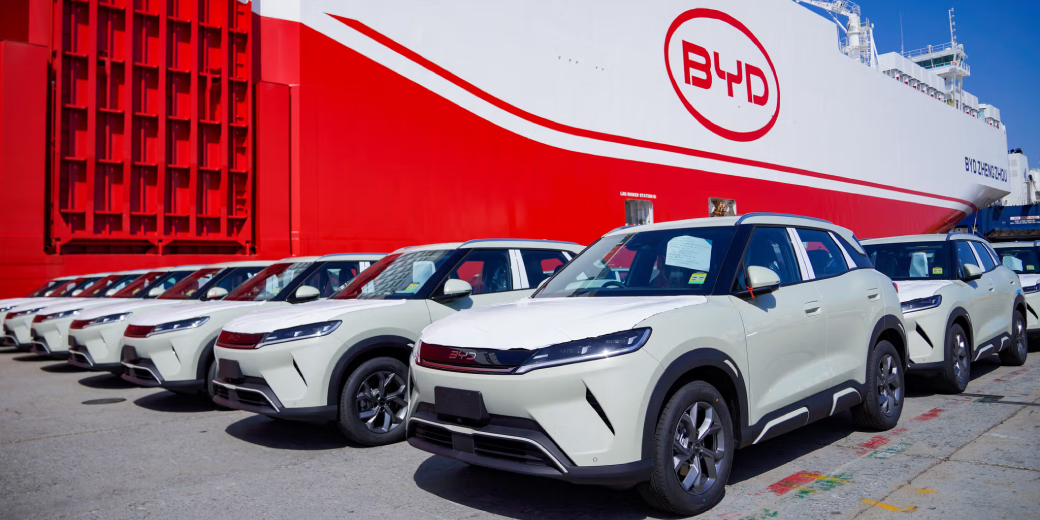
China's domestic car market is slowing sharply.
Its export machine is accelerating.
China Passenger Car Association data reported by Reuters showed domestic passenger-vehicle sales falling 21.1% year on year in July 2026 to 1.47 million vehicles.
Exports moved in the opposite direction.
They rose 88.2% to 923,000 vehicles.
Exports of electric and plug-in hybrid vehicles grew even faster.
That divergence explains why Chinese automakers are putting so much energy into Europe, Southeast Asia, Latin America and the Middle East.
The next export phase is not only about selling cheaper cars.
It is about getting Chinese software, driver-assistance systems and manufacturing strategies through foreign regulatory systems.
Domestic pressure is pushing companies outward
China's car market is brutally competitive.
Dozens of brands fight over price, range, technology and dealer incentives.
Weak domestic demand makes that competition harder.
Overseas growth offers an escape valve.
A company can absorb factory capacity and pursue higher margins in markets where Chinese EVs still feel new.
That strategy also creates political resistance.
Europe has tariffs on China-made EVs.
Governments worry about industrial dependence.
Safety regulators need to approve unfamiliar software systems.
Exporting the vehicle is the easy part.
Building a durable international business is harder.
Geely's EU driver-assistance certification is an important milestone
Geely says its G-ASD driver-assistance technology received certification for use under European standards.
Reuters described it as the first Chinese-developed auxiliary driving system to meet the relevant EU requirements.
That matters because software is becoming part of automotive market access.
A Chinese manufacturer can no longer win globally by shipping a battery and a competitive price.
It needs systems that satisfy local safety frameworks.
Certification turns smart-driving capability from a domestic marketing claim into something regulators will allow on foreign roads.
XPENG is testing the next layer in Europe
XPENG has also been using Germany as a test environment for its next-generation driver-assistance technology.
Its VLA 2.0 architecture and Next Generation Pilot are planned for broader international rollout from 2027, subject to local regulatory approval.
The company has demonstrated the system in Munich traffic.
That is significant because European roads, signs and driving behaviour differ from Chinese environments.
An AI driving system trained for one market does not become global simply because the steering wheel is on the same side.
Local validation matters.
Do not confuse assisted driving with autonomy
Marketing language around Chinese EV technology can become loose very quickly.
Systems labelled Level 2, Level 2+ or Level 2++ still require driver responsibility and supervision.
They are not robotaxis.
A vehicle that can change lanes, navigate complex roads or assist with parking is impressive.
The human remains responsible under the relevant system and legal framework.
That distinction must remain visible whenever manufacturers use ambitious terms such as intelligent driving or autonomous capability.
Price still matters, but sub-$30,000 claims need market context
Chinese automakers do sell highly capable vehicles at prices that would have been difficult to imagine a few years ago.
China-market prices can sit well below $30,000 for some models.
That does not mean the same vehicle reaches a European consumer at the same price.
Tariffs, VAT, shipping, homologation and distributor margins change the number.
A China price should never be converted directly into a European or Kenyan retail promise.
The real competitive advantage is the amount of hardware and software Chinese companies can include at a given manufacturing cost.
Local production is becoming the strategic answer
Chinese automakers are increasingly considering or building production outside China.
That can reduce tariff pressure and improve political acceptance.
Geely's cooperation with Ford around European manufacturing is one example of the broader direction.
XPENG has also been expanding local partnerships across international markets.
Southeast Asia is especially important because local assembly can support regional trade and reduce shipping costs.
The export model is gradually becoming an international-production model.
Why this matters for Africa
Africa is part of the same expansion map, even if the regulatory environment differs from Europe.
Chinese brands already have strong distribution in many African countries.
The opportunity is large because EV adoption is still early.
The challenge is infrastructure.
A sophisticated driver-assistance system is less useful if:
- Road markings are inconsistent
- Maps are incomplete
- Charging is scarce
- Service centres lack parts
Manufacturers that want African scale will need to localise for road and ownership conditions rather than simply ship cars built for Europe or China.
The tecMAMBO take
China's 88% export jump is not simply evidence that the world wants cheap Chinese cars.
It is evidence that Chinese manufacturers need the world as domestic demand weakens.
That creates a new competitive phase.
Price opens the door.
Software, certification, service and local production determine whether the company stays.
Geely's EU approval and XPENG's European testing show where the contest is moving.
The next global car war will be fought as much in code and regulation as in the battery pack.
Sources
Ask MAMBO
Have a plain-English question about this topic? Send it in and we may answer it in a future guide.
Ask a questionRelated reading
 MAMBO Explains
Phishing is learning to look legitimate because attackers are using trusted cloud platforms as infrastructure
Netskope says GitHub and Microsoft OneDrive each affected 10% of European organisations through cloud malware distribution. Trusted SaaS is becoming attacker infrastructure.
 MAMBO Take
Apple owns 65 percent of the premium phone market, but the number hides a changing battlefield
Counterpoint says Apple captured 65 percent of premium smartphone sales in H1 2026 as the premium segment reached a record 29 percent of the market.
 MAMBO Take
BYD, Geely and Chery are now global top-10 automakers. China is no longer the challenger
BYD ranked sixth, Geely seventh and Chery tied for ninth in H1 2026 global automaker market share, showing China's rapid international expansion.