

The iPhone 18 Pro's variable aperture, explained: why this camera rumor is the real deal
For once, a big iPhone rumor has factories behind it. Here is what a variable aperture actually changes, why it took Apple this long, and the rest of this year's credible iPhone 18 Pro picture, clearly labelled as the rumors they are.
First, the caution label: Apple has not announced the iPhone 18 Pro. Treat every hardware detail here as a credible rumor, not a finished spec sheet.
The reason this rumor deserves attention is that it has a supply-chain trail. Analyst Ming-Chi Kuo first said in December 2024 that both iPhone 18 Pro models would gain a variable- main camera. Digital Chat Station later repeated the claim from the Chinese supply side, and an April ETNews report added more concrete names: Sunny Optical supplying aperture actuators, with LG Innotek reportedly setting up equipment at its Gumi camera-module plant.
That is the point at which a rumor starts sounding less like forum smoke and more like a purchasing decision. Kuo has also estimated that the new camera unit could cost Apple about 50% more than the current wide camera, while Mark Gurman has described the next Pro camera package as a significant upgrade. None of that confirms Apple's launch plan, but it explains why this rumor has more weight than the usual case-color chatter.
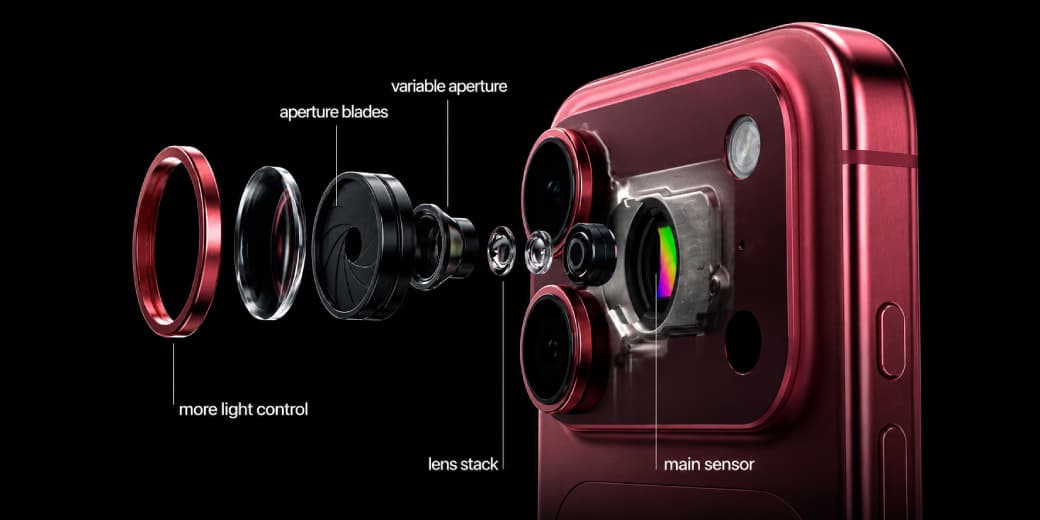
A variable aperture is simple in human terms. Think of the camera lens as an eye. A wider opening lets in more light, which helps at night and creates more background blur. A narrower opening lets in less light, which can keep more of a scene in focus and reduce blown highlights on bright days.
Phones have usually faked that control with software. Portrait mode guesses the subject, blurs the background, and hopes your hair or glasses do not confuse the edges. A mechanical aperture gives the camera actual optical control before the image hits the sensor. It does not make software irrelevant, but it gives the software a better starting point.
For ordinary photos, the benefit would be clearest in three places: low-light shots, close-up portraits, and scenes where several people are at different distances from the camera. A wider aperture could help the main camera gather more light without leaning as hard on long exposure. A narrower aperture could keep a group photo sharper from front to back.
There is still one awkward detail: not every source agrees on which iPhone gets it. Most reporting points to both the iPhone 18 Pro and iPhone 18 Pro Max. Macworld, however, has floated a more cautious possibility where the Pro Max gets the bigger aperture change and the smaller Pro focuses on telephoto improvements. That split matters because Apple has used camera features to separate Pro sizes before.
The thickness rumor is also unsettled. One recent claim said the iPhone 18 Pro models would be significantly thicker, but Macworld's own sourcing disputed that interpretation and expects a larger camera bump on a body that stays roughly the same size. In other words, do not buy a case on the rumor yet.
The rest of the iPhone 18 Pro picture is starting to fill in. The Pro models are expected to move to an A20 Pro chip built on TSMC's 2nm process, with 12GB of . Reports also point to a smaller Dynamic Island, with some Face ID components pushed under the display, plus Apple's C2 modem, mmWave support, and expanded satellite features.
The camera system may not stop at the aperture. Other rumors mention a 24MP front camera, a stacked Samsung-made sensor, and a brighter telephoto aperture. The Pro Max is also tipped for a battery around 5100mAh to 5200mAh, with a Dark Cherry color possibly joining the lineup.
The launch calendar may be changing too. The current rumor map has the iPhone 18 Pro and iPhone 18 Pro Max arriving in September 2026 alongside a foldable iPhone Ultra, while the standard iPhone 18 and iPhone 18e shift to spring 2027. That would make the Pro phones the main fall event instead of sharing the stage with every model at once.
That matters for buyers because Apple's camera story is now part of a bigger product split. If you are already watching the foldable iPhone Ultra, the smaller Dynamic Island rumor, or the iPhone Air trade-offs, the iPhone 18 Pro looks like the phone where Apple tries to make the regular slab exciting again.
For readers comparing Apple's cadence with Android, Samsung's latest foldable leak cycle shows the same pressure from the other side: mature phones need one or two real hardware reasons to feel new. A variable aperture would be one of those reasons, if Apple ships it.
So, is this the real deal? As rumors go, yes, it is one of the stronger ones. It has multiple analysts, a Chinese leaker, named suppliers, reported factory equipment, and a cost increase that fits the part. The healthy answer is still not confirmed. It is credible enough to watch closely.
FAQ
Will the iPhone 18 Pro have a variable aperture?
It is a strong rumor, not a confirmed Apple feature. Ming-Chi Kuo, Digital Chat Station, and supply-chain reporting have all pointed in the same direction, but Apple has not announced the iPhone 18 Pro.
What does a variable aperture do on a phone?
It physically adjusts how wide the camera lens opens. A wider aperture lets in more light and creates stronger natural blur, while a narrower aperture can keep more of a scene in focus.
When could the iPhone 18 Pro models launch?
Current reports point to September 2026 for the iPhone 18 Pro and iPhone 18 Pro Max, with the standard iPhone 18 and iPhone 18e possibly moving to spring 2027.
What other upgrades are rumored for the iPhone 18 Pro?
Rumors include an A20 Pro chip on TSMC's 2nm process, 12GB of memory, a smaller Dynamic Island, Apple's C2 modem, a 24MP front camera, a brighter telephoto lens, and a larger Pro Max battery.
Sources
The short version: if this lands, the iPhone camera gets less fake smart and more optically smart.
Ask MAMBO
Have a plain-English question about this topic? Send it in and we may answer it in a future guide.
Ask a questionRelated reading
 MAMBO Take
India wants to lock in electronics manufacturing until 2041, and Apple is a major reason why
India proposes extending tax exemptions for foreign electronics suppliers to 2041 as it scales smartphone, laptop, tablet and wearable manufacturing.
 MAMBO Take
Apple's 2026 iPhone plan could leave budget buyers waiting until 2027
A split launch would turn Apple's biggest 2026 phone event into a premium-only season and push value-conscious buyers toward older iPhones or Android.
 Should you care?
iPhone 18 Pro tipped for a much smaller Dynamic Island
The iPhone 18 Pro is tipped for a substantially smaller Dynamic Island, a rumor that fits Apple's slow move toward a cleaner all-screen front.