
Samsung's 2026 Mini LED TVs bring Vision AI to Kenya, but brightness still matters
Samsung is pushing AI picture and sound features into its 2026 TV range. That is useful, but buyers should still compare brightness, local dimming, ports and room conditions.
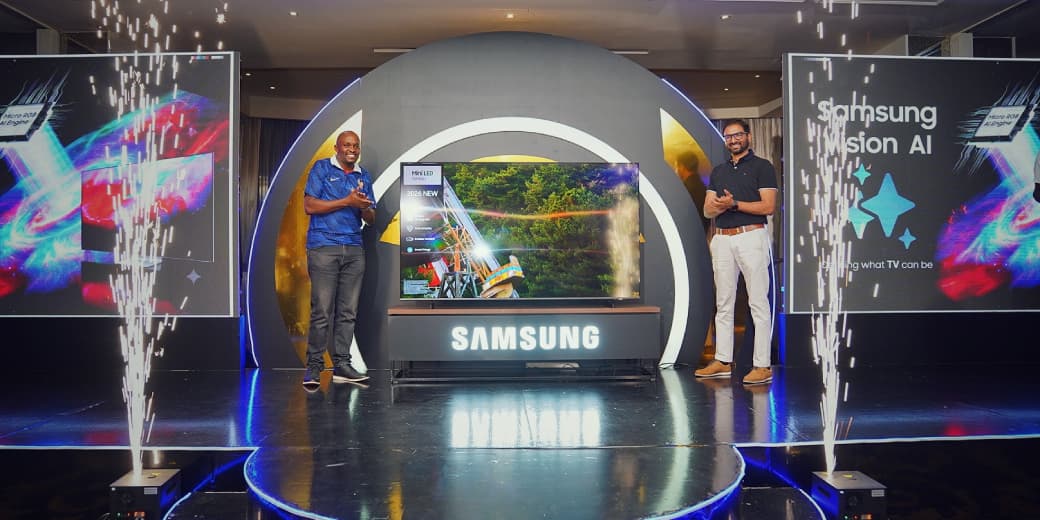
Samsung's 2026 home entertainment lineup pushes Mini LED and Vision AI features further into the living room, including models such as the M80H.
The pitch is bigger than picture quality. Samsung wants the TV to recognise content, improve motion, tune sound, upscale lower-quality video and personalise viewing through local processing and smart software.
That is useful, especially for sports, gaming and streaming. But Kenyan buyers should not let the AI label distract from the old fundamentals: brightness, contrast, local dimming, ports, warranty, room lighting and price.
A TV can be intelligent and still struggle against afternoon sunlight.
What you need to know
- Samsung's 2026 TV range includes Mini LED models such as M70H and M80H in several markets.
- Vision AI features include picture, sound and content intelligence across parts of the lineup.
- The M80H is positioned as a more capable Mini LED model with gaming-friendly specifications in global listings.
- Local Kenyan pricing and model availability should be confirmed through Samsung East Africa or authorised retailers.
- AI upscaling can improve low- content but cannot create detail that was never captured.
- Buyers should compare the M80H with Neo QLED, and discounted previous-year models.
What Samsung is selling with Vision AI
TV manufacturers used to compete mainly on panel type, size and resolution. Now they are selling intelligence.
Samsung's Vision AI branding covers a family of features that can include AI picture optimisation, AI sound tuning, upscaling, sports mode enhancements, gaming motion features, voice and content discovery, generative wallpapers, smart home integration and One UI Tizen software updates.
Some features vary by region and model. That sentence is boring but essential. The term Vision AI should therefore be read as a capability family, not a guarantee that every model has every feature.
What is Mini LED?
Mini LED is a backlighting technology for TVs. Instead of using fewer large LEDs behind the panel, Mini LED uses many smaller LEDs. This can give the TV better control over brightness and dark areas, especially when paired with good local dimming.
The benefit is stronger contrast than basic LED TVs, better brightness for bright rooms and improved HDR performance.
The limitation is that Mini LED is not OLED. The pixels do not individually switch off in the same way. Blooming around bright objects can still happen, depending on the panel and dimming system.
Mini LED can be excellent. It is not automatically flagship-grade just because the name sounds tiny and expensive.
Why AI processing matters in Kenya
Kenyan living rooms throw mixed content at a TV: YouTube, football, Showmax, Netflix, DStv, PlayStation, local news, old music videos and the occasional USB stick that has lived a long life.
AI upscaling and motion processing can help make lower-resolution or compressed content look better on a large 4K screen. That matters when is inconsistent or when content sources vary wildly in quality.
Still, AI upscaling has limits. It can clean edges, reduce noise and infer texture. It cannot turn a badly compressed clip into native 4K truth.
At some point, the source file must answer for its crimes.
What gamers should check
- 2.1 port count
- 4K at 120Hz or 144Hz support
- Auto Low Mode
- Input lag
- Game mode picture quality
- FreeSync or similar support
- eARC for sound systems
The M80H is listed globally with gaming-focused features such as Motion Xcelerator 144Hz in some markets. Kenyan buyers should verify the exact local model number. Regional variants can differ, and a one-letter suffix can ruin a very confident shopping plan.
M80H, Neo QLED or OLED?
Choose Mini LED when the room is bright, you watch sports often, you want strong brightness, you need less burn-in worry than OLED, and the price is below premium Neo QLED or OLED options.
Choose Neo QLED when you want Samsung's higher-end LCD performance and care about brightness, colour and local dimming quality.
Choose OLED when you watch movies in controlled lighting, want perfect blacks, value cinematic contrast and are comfortable managing burn-in risk.
The best TV is not the newest model. It is the right match for the room, content and budget.
What Kenyan buyers should ask before paying
- Is this the exact 2026 model or old stock?
- What is the full model number?
- Does the apply locally?
- Which Vision AI features are active in Kenya?
- How many HDMI 2.1 ports does it have?
- Does it support 120Hz or 144Hz at 4K?
- Is there local dimming?
- What is the real brightness performance?
- Are streaming apps region-supported?
- Can the retailer demonstrate sports, dark scenes and gaming mode?
Do not judge a TV only from a showroom loop. Those videos are built to make every panel look like a spiritual experience.
The tecMAMBO take
Samsung's 2026 Mini LED and Vision AI push is meaningful because TVs are becoming devices, not only screens.
Better upscaling, sound tuning and content awareness can genuinely improve daily viewing in bandwidth-variable markets like Kenya.
But the buying rule remains traditional: panel quality first, processing second, marketing third. AI can polish the picture. It cannot replace good hardware.
FAQ
What is Samsung Vision AI?
Vision AI is Samsung's branding for AI-powered TV features such as picture optimisation, sound tuning, content discovery and smart home functions across supported models.
What is the Samsung M80H?
The M80H is part of Samsung's 2026 Mini LED TV lineup in several markets and is positioned above entry Mini LED models.
Is Mini LED better than OLED?
Mini LED is usually brighter and less prone to burn-in concerns, while OLED offers pixel-level black levels and stronger cinematic contrast. The better choice depends on room and usage.
Should I buy a 2026 TV for AI features?
Only if the core TV is good. AI features are useful, but brightness, contrast, ports, gaming performance, warranty and price matter more.
Are all Samsung 2026 TV features available in Kenya?
Not necessarily. Features and models can vary by market. Confirm the exact model and regional feature support before buying.
Sources
Ask MAMBO
Have a plain-English question about this topic? Send it in and we may answer it in a future guide.
Ask a questionRelated reading
 Should you care?
Samsung goes Ultra: everything announced at the London Unpacked, from a 4.1mm Fold to Gemini glasses
Samsung's London Unpacked delivered the first Ultra foldable at 4.1mm, a wider Fold8, the Flip8, two new watches, and Gemini-powered smart glasses. Every announcement, explained.
 MAMBO Explains
Agentic AI is moving onto the device, and chipmakers want the phone or PC to become the execution layer
Qualcomm and MediaTek are building hardware and software for AI agents that can reason and act locally, reducing cloud dependence for some tasks.
 MAMBO Take
Apple's camera-equipped AirPods just leaked, and the privacy question is bigger than the hardware
A leaked Apple video inside macOS Tahoe 26.7 shows camera-equipped AirPods using Visual Intelligence. Here is what appears real and what remains unconfirmed.