

Agentic AI is moving onto the device, and chipmakers want the phone or PC to become the execution layer
Qualcomm and MediaTek are building hardware and software for AI agents that can reason and act locally, reducing cloud dependence for some tasks.
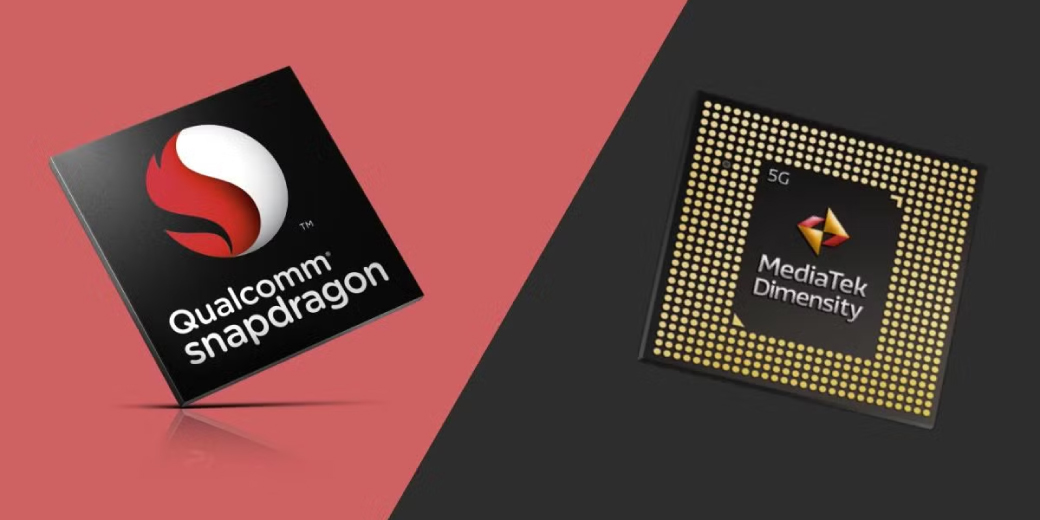
The next fight in AI hardware is not simply about making a chatbot answer faster.
It is about where the agent performs the work.
Qualcomm is demonstrating agentic applications running natively on Snapdragon X Series PCs.
Its mobile platforms are being positioned for agentic actions such as opening apps, analysing documents and creating calendar events locally.
MediaTek has been building its own Dimensity Engine around a similar idea: sense context, reason about intent and act across device functions.
The common strategy is clear.
will remain important.
But chipmakers want more AI work to happen on the device sitting in your hand or on your desk.
Why local execution matters
Cloud AI is powerful because data centres can run much larger models than phones.
The trade-off is that every request creates a round trip.
That affects:
- Connectivity dependence
- Server cost
- Privacy
- Battery and network use
An agent is more demanding than a chatbot.
A chatbot can wait for a question.
An agent may monitor context, remember a task, use tools and take several actions.
Sending every small step to the cloud can become expensive and slow.
That is why NPUs are becoming central to the hardware pitch.
Qualcomm is showing real local agent workloads
Qualcomm's August 2026 demonstrations include software partners running on Snapdragon X Series systems.
The company highlights local processing for tasks such as document interaction, screen-aware assistance, long-context reasoning, search, speech processing, local memory and tool use.
The point is not that every agent can remain offline.
The point is that enough of the workflow can stay local to reduce cloud dependence.
That becomes particularly attractive for enterprises dealing with confidential documents.
Smartphones are heading in the same direction
Qualcomm's mobile AI platform describes agentic actions such as opening applications, analysing files and retrieving information.
MediaTek has been pushing similar concepts through its Dimensity platforms.
At MWC 2026, MediaTek demonstrated capabilities including camera agents and multimodal processing.
Its earlier Dimensity Agentic AI Engine was designed around the sequence:
Sense.
Reason.
Act.
That language tells you where smartphone design is heading.
The operating system is slowly becoming an environment an AI can manipulate, not simply an environment where an AI chat window lives.
Screen understanding is only half the problem
An agent that can read the screen can understand what is happening.
Taking action is harder.
Operating systems need controlled interfaces that let assistants:
- Open apps
- Select options
- Enter information
- Request permissions
- Confirm sensitive actions
If agents rely on visually clicking buttons like a person, they can be brittle.
A redesigned operating system can expose structured actions to the agent.
That is where Apple, Google, Microsoft, Qualcomm and MediaTek all have incentives to collaborate and compete.
Privacy becomes a hardware feature
Local inference can keep more context on the device.
That is valuable when the agent is reading email, documents, calendar, messages and work files.
But local does not automatically mean private.
An application can still collect telemetry.
A local agent can still be poorly permissioned.
A device can still sync outputs to the cloud.
The important question is not simply where the model runs.
It is what data leaves, when it leaves and who can access the action history.
Battery becomes part of AI quality
A model that works beautifully for ten minutes but destroys is not useful mobile AI.
Chipmakers therefore need to optimise:
- Model size
- NPU utilisation
- Thermal behaviour
- Background activity
This is why local AI is a silicon problem as much as a software problem.
The user does not care how impressive the benchmark is if the phone becomes hot while the assistant checks a calendar.
The cloud still wins some jobs
Large reasoning tasks will continue to benefit from data-centre models.
The likely future is hybrid.
Small, private or latency-sensitive steps happen locally.
Larger tasks move to the cloud when needed.
The product challenge is making that handoff invisible and understandable.
Users should not need to become network architects every time an agent completes a task.
The tecMAMBO take
Agentic AI is forcing hardware back into the AI conversation.
For the last few years, model companies made the headlines.
The next phase depends on processors, memory, battery efficiency and operating-system permissions.
The winning agent will not be the one that can produce the longest answer.
It will be the one that can quietly complete useful work without draining the battery, exposing private context or asking the cloud for permission every five seconds.
That makes the phone and PC much more than AI clients.
They are becoming execution environments.
Sources
Ask MAMBO
Have a plain-English question about this topic? Send it in and we may answer it in a future guide.
Ask a questionRelated reading
 Should you care?
Google Pixel 11 Series Arrives with Tensor G6, HiLight, Better Cameras and Higher Starting Prices
Google's Pixel 11 family is official, bringing Tensor G6, brighter displays, new camera hardware, Proactive Assistance, Qi2.2 charging and the return of notification lights through HiLight.
 Should you care?
Samsung goes Ultra: everything announced at the London Unpacked, from a 4.1mm Fold to Gemini glasses
Samsung's London Unpacked delivered the first Ultra foldable at 4.1mm, a wider Fold8, the Flip8, two new watches, and Gemini-powered smart glasses. Every announcement, explained.
 MAMBO Explains
TECNO EllaClaw shows the next phone war is not megapixels. It is agents
Smartphone AI is moving from photo tricks to agents that act across apps. TECNO's EllaClaw shows why budget phones may become the real test ground.