
Africa's biggest fintech IPO candidates are looking offshore, and local exchanges should ask why
OPay is preparing for a US IPO, Airtel Money is targeting London and PalmPay is exploring Hong Kong. Africa's fintech exit problem is becoming visible.
Three of Africa's most closely watched fintech businesses are moving toward public markets.
None of their preferred venues is an African exchange.
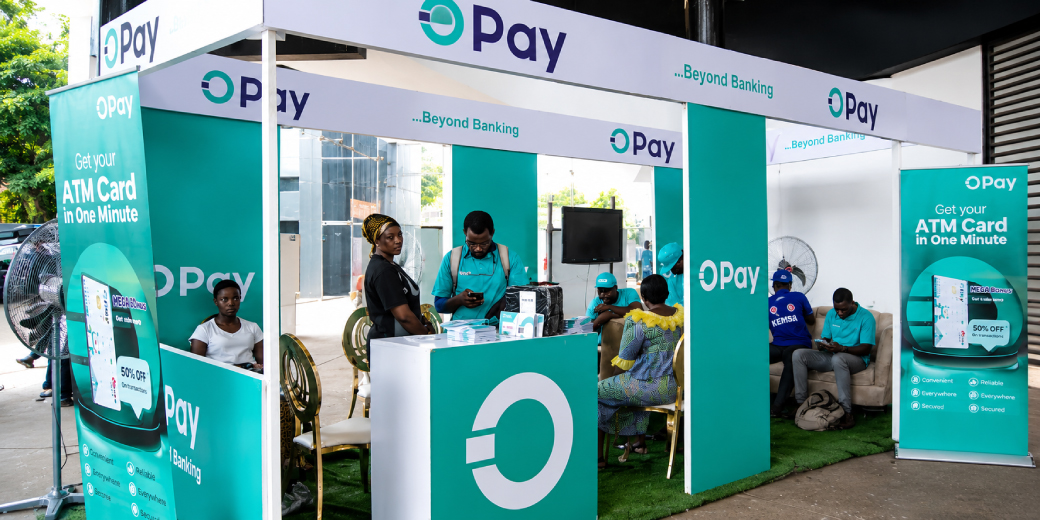
OPay is preparing for a potential US listing.
Airtel Africa says it intends to list Airtel Money in the second half of 2026, subject to market conditions, with London reported as the target venue.
PalmPay is exploring a Hong Kong route and has reportedly been seeking capital ahead of a potential listing.
These companies are not at the same stage.
It would be inaccurate to say all three have filed formal public listing documents.
The common direction is still hard to miss.
When African fintechs reach the stage where founders and investors want deep liquidity, large institutional buyers and international price discovery, they keep looking abroad.
OPay is preparing for New York
Bloomberg reported that OPay is working with Citigroup, Deutsche Bank and JPMorgan as it prepares for a US IPO.
The Nigeria-focused payments company is reportedly seeking a valuation around $4 billion.
Standard Bank has also been reported to be in talks about buying a stake before the listing.
Those discussions may not result in a transaction.
OPay itself has not publicly confirmed every reported detail.
The signal is nevertheless clear.
A fintech built around one of Africa's largest consumer markets sees New York as a likely place to convert private-market scale into a public valuation.
Airtel Money is targeting London
Airtel Africa's position is more explicit.
Its 2026 annual report states that Airtel Money is well positioned for a standalone listing and that the group intends to undertake an IPO in the second half of 2026, subject to market conditions.
Reuters later reported London as the planned venue.
Airtel Money has tens of millions of customers across African markets.
A London listing would give global investors a cleaner way to buy exposure to African without purchasing the entire telecom group.
It would also mean the liquidity event happens outside the markets where most of the customers live.
PalmPay is looking toward Hong Kong
PalmPay is closely associated with African digital payments, particularly Nigeria.
Semafor reported that it is seeking roughly $200 million ahead of a potential Hong Kong IPO that could value the company above $1 billion.
That is not the same as a completed listing application.
It is part of the preparation phase.
Hong Kong makes strategic sense because PalmPay has strong links to Chinese capital and technology networks, including backing connected to Transsion and NetEase.
Why offshore markets are attractive
Founders and investors care about more than prestige.
They care about liquidity.
A large international exchange can provide:
- Deeper institutional capital
- More specialist technology investors
- Higher trading volumes
- Greater analyst coverage
- Hard-currency valuation
- Better conditions for large secondary sales
An IPO is not simply a fundraising event.
It is also an exit mechanism for early investors and employees.
A company can be operationally African while its capital-market needs are global.
The foreign-exchange problem
Currency stability matters.
A business earning naira, shillings, cedis or other African currencies may still have investors whose fund returns are measured in dollars.
Listing in London, New York or Hong Kong can make that relationship easier to understand.
Local exchanges cannot fix macroeconomic volatility by redesigning an IPO prospectus.
They can, however, improve everything around it.
What African exchanges are missing
The Nigerian Exchange and Nairobi Securities Exchange have sophisticated listed companies.
They have not yet become obvious destinations for technology scale-ups.
That creates a structural problem.
African pension funds, retail investors and local institutions can use the products of these fintechs every day but may struggle to own them when the wealth-creation event arrives.
The public-market value accrues elsewhere.
That is not only a national-pride issue.
It affects the development of domestic capital markets.
Technology companies bring new sectors, younger investors, growth-style valuation models, new analyst expertise and more varied index composition.
If every major African technology exit goes offshore, local markets remain dominated by the same mature sectors.
Could dual listings help?
A practical middle ground may be a dual listing, domestic tranche or later secondary listing.
That would allow the company to access deep international capital while giving local investors some route to ownership.
It is not simple.
Cross-listings create regulatory, reporting and liquidity costs.
But the alternative is a growing class of African technology companies whose customers are local while public ownership remains mostly foreign.
The tecMAMBO take
African fintechs choosing foreign exchanges is rational.
That is precisely why local exchanges should be worried.
The companies are telling the market what they value: liquidity, hard-currency capital, specialist investors and global visibility.
The answer is not to guilt founders into local listings.
It is to make African public markets competitive enough that a dual listing, local tranche or domestic-first route becomes economically sensible.
A continent that creates globally important fintech companies should eventually build capital markets capable of owning more of them.
Sources
Ask MAMBO
Have a plain-English question about this topic? Send it in and we may answer it in a future guide.
Ask a questionRelated reading
 Business
Yellow's new Series C is a bet that the next billion-dollar African credit product may be an asset, not cash
Yellow has closed a Series C backed by Convergence Partners and SSI as it scales asset financing for smartphones and solar systems across seven African markets.
 Business
Safaricom's new board appointments show what Vodacom's 55% control looks like in practice
Safaricom's appointment of two senior Vodacom executives is more than a routine board refresh. It shows how the telco's new majority ownership is beginning to shape governance.
 MAMBO Take
M-Pesa Ethiopia users can now turn wallet balance into cash at Bank of Abyssinia ATMs
A new Bank of Abyssinia integration gives M-Pesa Ethiopia customers another way to cash out, turning existing ATM infrastructure into part of the mobile-money network.