

Inside Kenya's "Startup Graveyard": Twiga Joins a KES 93 Billion Wreckage, and One Number Complicates the Story
Twiga Foods joins Kenya's so-called "startup graveyard," 13 collapsed ventures that raised a combined KES 93 billion in five years. Here's what the pattern actually shows, and what it doesn't.
Quick answer
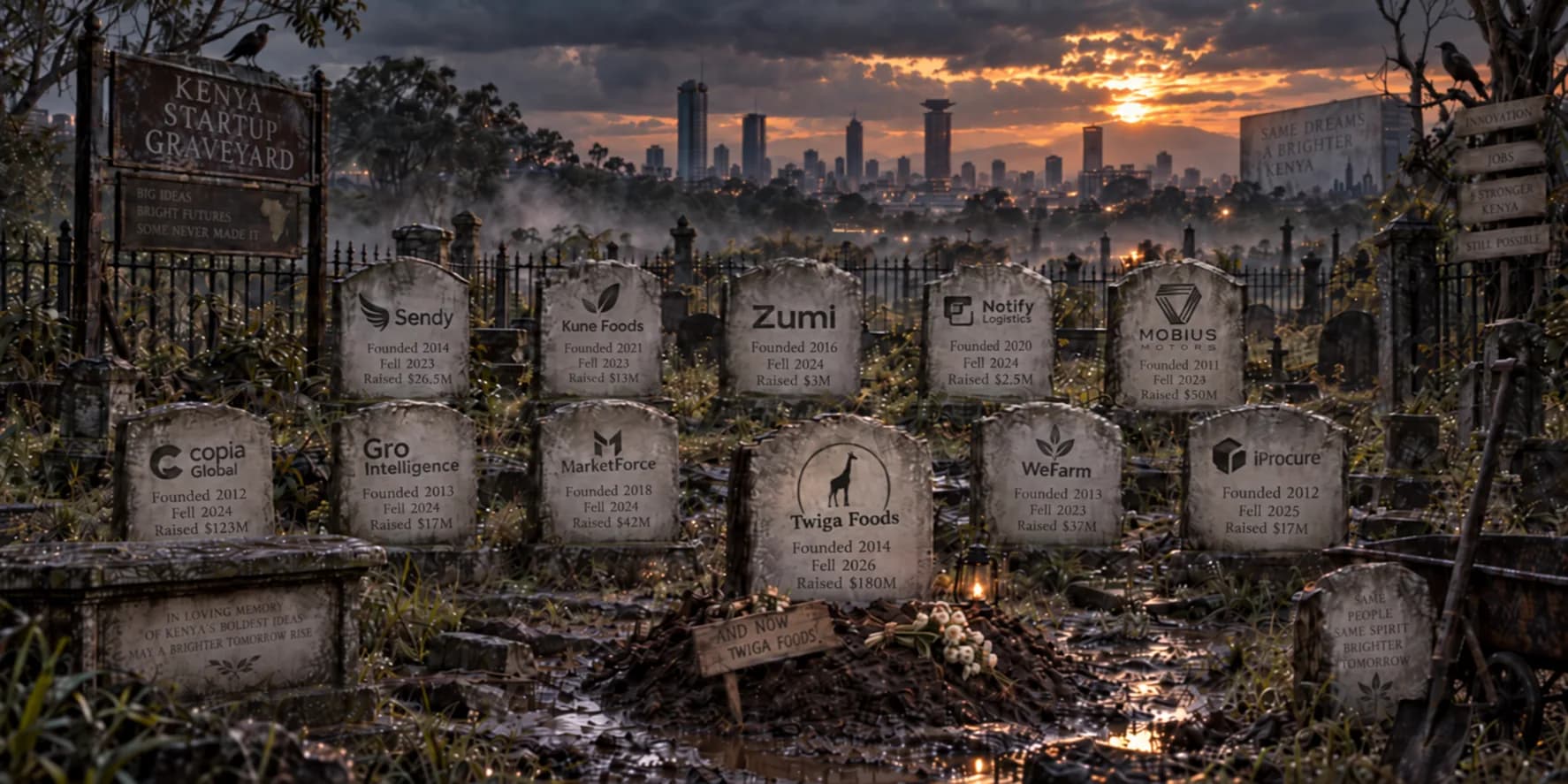
This is a labeled analysis piece, not neutral reporting. Twiga Foods' entry into administration this month joins a documented group of 13 once-prominent Kenyan startups that have shut down, entered administration, or liquidated over the past five years, after collectively raising more than KES 93 billion, roughly $718 million. The pattern spans agritech, logistics, e-commerce, and fintech, and most failures trace to the same root cause: asset-heavy, low-margin distribution models built to chase growth metrics rather than unit profitability, then exposed once venture funding tightened. One case, Gro Intelligence, involves a genuine, documented SEC fraud investigation and a wrongful-termination lawsuit, real accountability questions rather than speculation. A complicating fact worth holding alongside all of this: Kenya was still Africa's single largest venture capital destination in 2025, at $984 million, more than any other country on the continent, the same year several of its highest-profile startups from the previous cycle were already failing.
When GT Flow Limited, Twiga Foods' operating entity, entered statutory administration this month, the reaction across Nairobi's tech scene wasn't shock. It was recognition of a pattern that's been building for half a decade.
The number, and what it actually counts
Twiga's collapse puts it alongside 12 other once-prominent Kenyan startups that have shut down, entered administration, or gone through liquidation over the past five years, after collectively raising in excess of KES 93 billion. That figure and that company count come from Business Daily Africa's own reporting on Twiga's administration, and it's corroborated across multiple independent outlets covering the same story this week.
The full list, as reported: Twiga Foods, Copia Global, Gro Intelligence, MarketForce, Sendy, iProcure, Koko Networks, Lipa Later, Mobius Motors, Wefarm, Notify Logistics, Kune, and Zumi. Individual funding figures, where independently confirmed:
| Feature | Sector | Funding raised | Outcome |
|---|---|---|---|
| Twiga Foods | Agritech / B2B distribution | More than $180 million | Statutory administration, September 2026 |
| Copia Global | E-commerce / rural retail | $123 million | Administration, May 2024 |
| Gro Intelligence | Agri-climate data | $117.7 million | Shutdown, mid-2024, after 60% layoffs |
| MarketForce | B2B FMCG distribution | $84.1 million per Business Daily; $42.5 million per an alternate source citing a $40 million Series A | Wound down, April 2024 |
| Sendy | On-demand logistics | $24.7 million | Shutdown, 2023 |
| Lipa Later | Buy-now-pay-later fintech | Over $16 million | Administration, March 2025 |
| iProcure | Agri-input distribution | $17.1 million | Administration, April 2024 |
Mobius Motors, Wefarm, Notify Logistics, Kune, Koko Networks, and Zumi complete the 13-company cohort; specific, independently confirmed funding figures for each weren't available at the time of this report and are not included in the table to avoid overstating precision the sourcing doesn't support. Mobius Motors' story has a distinct ending worth noting on its own: rather than fully dissolving, it was acquired out of bankruptcy in 2025 by Silver Box, a Middle Eastern investment firm, a rare case in this list where assets found a buyer rather than simply winding down.
What actually killed most of these companies
The pattern across the companies with the most detailed public post-mortems is consistent, and it's less dramatic than a single villain narrative. These were largely asset-heavy distribution businesses, Twiga and Copia moving physical goods to informal retailers, iProcure moving agricultural inputs, Sendy moving parcels, competing in markets with thin margins and low customer switching costs. Growth in that model requires continuous working capital to buy and move inventory ahead of receiving payment for it. When venture funding was abundant, that gap got bridged by the next round. When funding tightened globally from around 2022 onward, several of these companies hit the same wall simultaneously: unable to raise a next round on acceptable terms, unable to cut costs fast enough to reach breakeven, and carrying operating models that hadn't been built to survive without continuous external capital.
Specific, sourced examples bear this out. MarketForce lost a committed investor partway through a funding round before eventually winding down its RejaReja platform in April 2024. Sendy became insolvent in 2023 after a key investor pulled out of what would have been a down round, having earlier tried and failed to raise $100 million to keep expanding. Copia left the Ugandan market in 2023, raised a further $20 million, and still couldn't secure enough follow-on capital to avoid administration in May 2024, after peaking at 1,800 employees and more than 50,000 agents. iProcure's model required buying and transporting agricultural inventory before cash came back in, a permanent working-capital drain that a commercial marketplace expansion made more complex rather than less, before it entered administration in April 2024 after failing to pay creditors.
The one case with real, documented accountability questions
It's worth being precise about where actual misconduct allegations are documented versus where they're speculation, since conflating the two does a disservice to a genuinely serious story.
Gro Intelligence is the clearest case. Beyond the standard funding-crunch narrative, the company is reportedly under investigation by the US Securities and Exchange Commission over allegations of fraud, and former employees sued the company over alleged labor violations after being laid off without notice when it cut 60% of its workforce in March 2024. Those are documented, sourced facts, not an inference drawn from a company's failure alone. Gro's founder and CEO, Sara Menker, was replaced before the company's final shutdown and has largely stayed out of public view since.
That specific, documented case is a more honest basis for asking hard questions about executive accountability in this sector than a general allegation about executive pay patterns across the whole cohort would be, since no verified, sourced figures for executive compensation across these companies were found in preparing this piece. Readers should treat any specific dollar figures attached to executive pay at any of these companies, wherever they encounter them, with real skepticism unless a primary source is cited.
The founders who didn't just disappear
One detail worth adding, because it complicates a simple "founders extract value and walk away" narrative: at least one prominent failure in this list led directly to a new venture rather than an exit. MarketForce's founders, Tesh Mbaabu and Mesongo Sibuti, didn't stop building after RejaReja shut down. They went on to launch Chpter, and later Cloud9, which launched in Kenya in December 2025 and acquired Chpter in August 2026. That's not proof the broader accountability question is unfounded across the whole sector, but it is a real data point against treating every founder in this cohort as having simply cashed out and left.
The complicating fact: Kenya still leads Africa on VC dollars
Here's the part of this story that a pure "graveyard" framing leaves out entirely. In 2025, the same broad period several of the companies above were failing or had already failed, Kenya was Africa's single largest venture capital destination, attracting $984 million according to the startup funding tracker Africa: The Big Deal, more than any other African country that year.
That's a genuinely uncomfortable data point for a simple decline narrative, and it's worth sitting with rather than smoothing over. It suggests investors haven't actually concluded Kenya is uninvestable; they've kept allocating more capital to it than anywhere else on the continent, even as its most visible prior cohort of bets was visibly failing in public. Whether that reflects genuine confidence in a new generation of Kenyan founders and business models, inertia in how global funds allocate across Africa, or simply a market too large and too well-networked to ignore despite its failure rate, is a real open question this data alone can't answer.
Why comparisons to Nigeria and South Africa are worth some caution
It's tempting to point at Nigeria's Paystack and Flutterwave, or South Africa's Takealot, TymeBank, and Discovery Bank, as evidence those ecosystems simply do this better. There's something real in that comparison: fintech and payments infrastructure businesses generally have structurally better unit economics from earlier in their life than asset-heavy physical distribution businesses do, which is a genuine, mechanical difference in business model rather than a difference in founder or investor quality. But it's also worth noting that Nigeria and South Africa have had their own well-documented startup failures, and that Kenya's specific cohort skews unusually heavily toward physical distribution and agritech, sectors that are inherently harder to make capital-efficient than payments infrastructure is, almost anywhere in the world. The comparison is worth making. It shouldn't be made as if Kenya's founders or investors are uniquely flawed relative to peers operating in structurally easier categories.
The tecMAMBO take
The honest version of this story isn't "Kenya's startup ecosystem is broken" or "Kenya's startup ecosystem is fine, these are just growing pains." It's narrower and less satisfying than either: a specific, identifiable cohort of asset-heavy distribution businesses, built on a funding model that assumed continuous access to capital, hit a funding environment that stopped assuming that, at roughly the same time. Some of those failures involved real documented accountability questions, Gro Intelligence's SEC investigation chief among them. Most didn't need a villain at all; they needed a business model that could survive a funding winter, and didn't have one.
What should worry Kenya's ecosystem more than the KES 93 billion figure itself is whether the next generation of heavily funded startups is building toward capital efficiency from day one, or toward the next round. Kenya remaining Africa's top VC destination in 2025 means investors are still betting billions on that question being answered correctly this time. The KES 93 billion already lost is the evidence for why that bet is worth taking seriously rather than assuming it'll simply work out because it's Kenya's turn.
FAQ
How many Kenyan startups have failed in the past five years?
Thirteen prominent, well-funded startups have shut down, entered administration, or liquidated over the past five years, according to Business Daily Africa's reporting, following Twiga Foods' entry into administration in September 2026.
How much funding did these failed startups raise combined?
More than KES 93 billion, approximately $718 million, across the 13 companies.
Is there evidence of executive misconduct in these failures?
One case, Gro Intelligence, involves a documented SEC investigation into fraud allegations and a former-employee lawsuit over unpaid, no-notice layoffs. No verified, sourced evidence of specific executive compensation figures across the broader group of companies was found.
Did Kenya stop attracting venture capital because of these failures?
No. Kenya was Africa's largest venture capital destination in 2025, attracting $984 million, more than any other African country that year.
Sources
- Business Daily Africa: Investors lose Sh93bn in Kenya startup failures
- WeeTracker: Kenya Startup Failures Worsened By Flameout Of Once-Celebrated B2B Star
- Business Tech Africa: These Kenyan startups raised millions before shutting down
- Semafor: A Kenyan agri-data startup tipped to underpin global food security shuts down
- CIO Africa: Kenyan Startup Gro Intelligence Shuts Down
- U.S. District Court docket: Bielefeldt et al v. Gro Intelligence, Inc.
Share this story
Enjoyed this? Share it with someone who'd appreciate it.
Ask MAMBO
Have a plain-English question about this topic? Send it in and we may answer it in a future guide.
Ask a questionRelated reading
Twiga Foods is in administration, and the paperwork traces years of trouble most people missed
GT Flow Limited, the operating entity formerly known as Twiga Foods One Limited, entered statutory administration in Kenya on August 17, 2026, confirmed by a Kenya Gazette notice published September 11.

Apple TV just came to Kenya for the first time, bundled into a $0.99 cloud storage plan
Apple TV is available for the first time ever in Kenya as of this month, bundled at no extra cost into every paid iCloud+ subscription, including the entry-level 50GB plan, which stays at $0.99 a month, roughly KES 128.
Kenya's High Court just unwound a $1.58 billion Safaricom sale that closed three months ago
Kenya's High Court declared the government's sale of a 15% stake in Safaricom PLC to Vodacom Group unconstitutional, null and void, and ordered the shares restored to the state.