

Kenya won big at Huawei's ICT Competition. Medals are only the beginning
All three Kenyan university teams returned with global honours. The next test is turning competition success into research, products and well-paid technology careers.
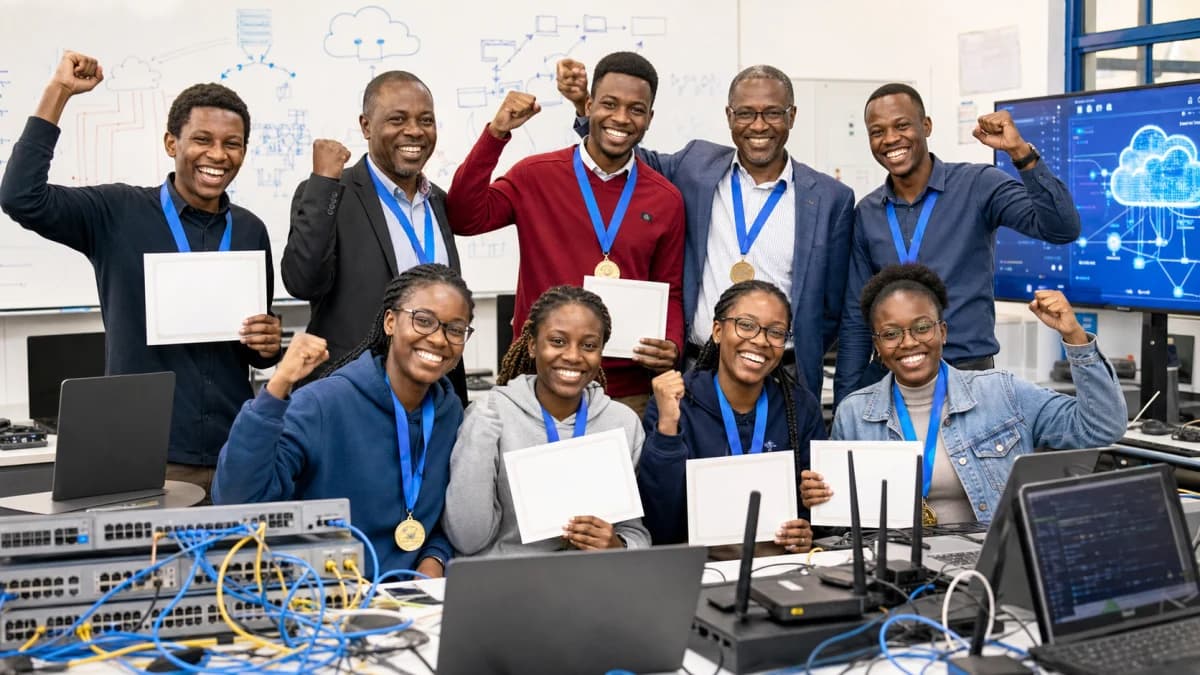
Three Kenyan university teams returned from the 2026 Huawei ICT Competition global finals with awards.
Track team won the Grand Prize, Kenya's first top honour since joining the contest in 2019. A Network Track team won second prize. An all-women Computing team from Jomo Kenyatta University of Agriculture and Technology won second prize and the Women in Tech Award.
President William Ruto hosted the winners at State House on 28 July and launched registration for the competition's next edition.
The results are worth celebrating. They are also a test of whether Kenya can convert student excellence into research, companies and careers.
Competition results show performance under pressure. Lasting career value also depends on documentation, collaboration, security, reliability and the ability to maintain real systems after judging ends.
What you need to know
- More than 220,000 participants from over 2,000 institutions entered globally.
- Only 177 teams from 49 countries reached the finals in Shenzhen.
- Kenya's Cloud Track team won the Grand Prize.
- Kenya's Network Track team won second prize.
- JKUAT's all-women Computing team won second prize and the Women in Tech Award.
- Huawei says its academy programme has trained more than 15,000 Kenyan students.
Who won?
The Cloud Track team included lecturer Kevin Tuei of Tharaka University, Catherine Atieno of JKUAT, Brian Ngugi of Mount Kenya University and Salem Kim of Machakos University.
The Network Track team included lecturer Franklin Mutisya of Machakos University, Denzel Nzinga of Multimedia University, Robert Wambua of Kenyatta University and Joy Wairimu of the Co-operative University of Kenya.
JKUAT's all-women Computing team was led by lecturer Esther Wairimu and included Joan Nkatha, Malane Minayo and Faith Masonik.
PC Kinyanjui Technical Training Institute also became the first Kenyan TVET institution to qualify for the regional finals.
Why the Cloud Grand Prize matters
Modern finance, e-commerce, government platforms, AI systems and enterprise applications depend on engineers who understand networks, , databases, security and distributed systems.
The team's award signals that Kenyan students can compete at a high technical level. It does not prove that Kenya already has enough local cloud capacity or jobs.
Many African professionals still build on infrastructure owned elsewhere and priced in foreign currency. The strategic opportunity is to move from using cloud services to designing, securing and operating more of the systems around them.
A medal can announce talent. Infrastructure decides where that talent works.
Why the all-women team matters
Women remain underrepresented in infrastructure, cybersecurity and advanced computing.
An all-women team winning both a computing prize and a dedicated technology award provides visible evidence against the lazy assumption that the pipeline is empty.
Visibility matters, but celebration should not substitute for structural work. Universities and employers still need fair recruitment, safe learning environments, mentorship, paid internships and leadership pathways.
A photograph of successful women cannot repair an institution that makes it difficult for the next group to stay.
What Huawei gains
Huawei's academy programme trains students in networking, cloud and computing. The company says it has worked with 61 Kenyan institutions, trained more than 15,000 students, certified over 6,000 learners and equipped more than 400 lecturers.
The programme can expand access to current enterprise tools. It also develops a workforce familiar with Huawei's ecosystem.
That is a normal strategic benefit for a technology vendor. Kenya should recognise it without pretending that corporate training is neutral philanthropy.
What universities and employers should do next
Universities should create open laboratories, fund faculty coaching, connect projects to local problems, publish technical lessons and support open-source contribution.
Employers should provide paid internships, apprenticeships, graduate engineering programmes, real production exposure and skills-based recruitment.
The point is not to hire only award winners. It is to reproduce the conditions that made them capable.
Is Kenya becoming a global digital-talent hub?
Kenya has credible strengths in universities, developer communities, regional headquarters, cloud investment, startup experience and outsourcing.
The weak points remain uneven education quality, expensive equipment, limited research funding, few deep-tech employers, brain drain and weak entry-level pathways.
Calling Kenya a talent hub can attract investment. It can also become a flattering way to export skilled labour without building local intellectual property.
How students can turn competition experience into career evidence
Competition success is most valuable when students can translate it into language that employers and collaborators understand. A medal is impressive, but a clear account of the work is even stronger.
Participants should document the problem, architecture, tools, team roles, trade-offs, failures and final result. Where competition rules permit, they should publish technical write-ups, diagrams, demonstrations or open-source components. They should also explain what they would change with more time. That reflection shows judgement rather than memorisation.
Students who did not reach the final can use the same approach. A functioning cloud deployment, network simulation, security lab or computing project can become credible portfolio evidence when the owner explains why the system was designed that way and how it was tested.
Universities can help by maintaining public project repositories, arranging employer review days and connecting teams to internships after the event. Huawei and other sponsors can publish anonymised skill rubrics so that learners understand what strong performance looks like.
The career value should not depend entirely on a recruiter recognising the competition name. The work itself should remain visible after the ceremony.
Should you care?
Yes.
The achievement shows Kenyan students can compete globally in cloud, networking and computing.
The deeper opportunity is to connect classrooms to laboratories, laboratories to companies and companies to global markets.
That chain cannot stop at certification.
FAQ
What did Kenya win at the Huawei ICT Competition?
Kenya won the Cloud Track Grand Prize, second prize in the Network Track, second prize in the Computing Track and the Women in Tech Award.
Where were the global finals held?
The finals were held in Shenzhen, China.
How many teams reached the finals?
The official presidential statement said 177 teams from 49 countries qualified.
Which Kenyan team won the Women in Tech Award?
An all-women Computing team from JKUAT received the award.
Is the Huawei ICT Academy free?
Programme terms vary by institution and course. Students should check with participating institutions.
Sources
Ask MAMBO
Have a plain-English question about this topic? Send it in and we may answer it in a future guide.
Ask a questionRelated reading

South Africa is ready to scale AI. Access and infrastructure could still split the winners
The conference moved past chatbot demos toward energy, banking, public services and telecom infrastructure. The harder question is who can participate.

Kenya wants Oracle's cloud and AI expertise. It should negotiate like the data matters
Oracle and the ICT Authority are exploring deeper cooperation on government cloud, AI and certification. Kenya needs skills transfer, interoperability and enforceable data controls.

NVIDIA's RTX Spark wants to reinvent the Windows PC
NVIDIA's RTX Spark platform is a direct challenge to Intel and AMD in Windows PCs, built around local AI, Arm, Blackwell graphics, and huge shared memory.