
Kenya's plan to put AI in eight million small businesses, explained
The government is pushing AI into the shops, workshops, and traders that make up most of the economy, just as the Senate debates the rules that will govern it.
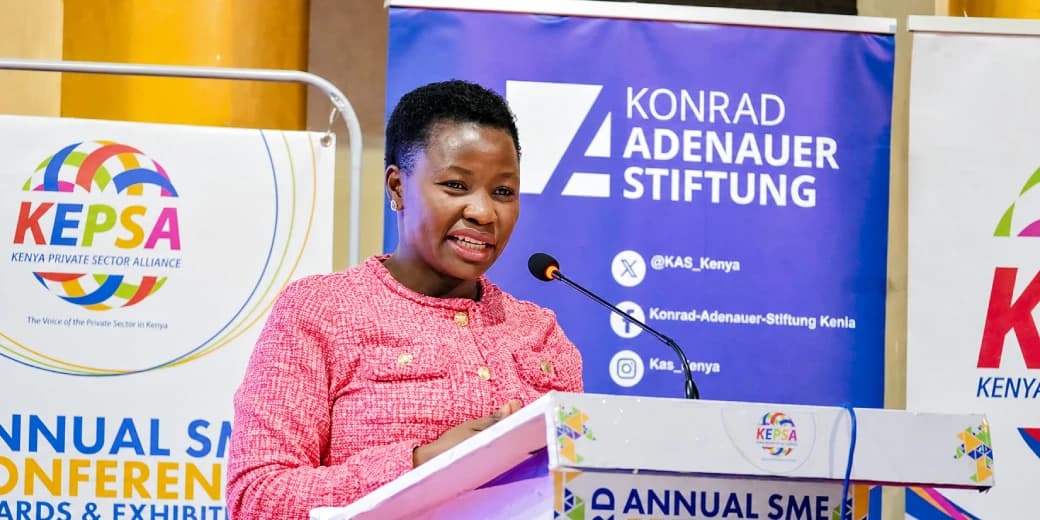
Kenya wants artificial intelligence to stop being a big-company tool and start working inside the small businesses that carry most of the economy. The Ministry of MSME Development has unveiled a national push to mainstream AI across nearly eight million micro, small, and medium enterprises, the shops, salons, workshops, farms, and traders that employ the majority of working Kenyans. It lands at the same moment the Artificial Intelligence Bill 2026 is moving through the Senate, so the country is trying to spread a technology and write its rulebook at the same time. Here is what the plan promises, what the law would change, and where the gap between the two could open.
What the MSME AI drive actually proposes
The pitch, pushed by the ministry and its principal secretary, is that AI can become the next engine of Kenyan enterprise rather than a luxury for large firms. In practice that means encouraging small businesses to use AI for the unglamorous work that eats their time: tracking inventory, writing quotes and invoices, answering customers, drafting marketing, and forecasting demand. The stated goals are to automate stock and record-keeping, streamline local manufacturing, and lift competitiveness so Kenyan firms can trade under the African Continental Free Trade Area rather than being undercut by bigger regional players.
The reason the target is small business and not the corporate tower is simple arithmetic. MSMEs are estimated to contribute somewhere between a quarter and a third of Kenya's gross domestic product and the bulk of its jobs. A tool that shaves an hour of admin off a trader's day, or helps a workshop price a job correctly, does not sound dramatic, but multiplied across millions of firms it is exactly where productivity gains would show up in real incomes.
Why small businesses are the right place to aim
Most Kenyans do not work for a company with an IT department. They run or work in a stall, a boda operation, a tailoring shop, a small farm, or a one-person service. Margins are thin and time is the scarcest resource. That is why the most useful AI for this group is not a flashy model but a cheap assistant that removes friction: a mama mboga checking stock and pricing, a fundi turning a rough spec into a written quote, a salon managing bookings and reminders, a small exporter drafting listings for a cross-border marketplace. The free and low-cost tiers of today's assistants already do much of this, which is what makes a mass-adoption drive plausible rather than aspirational.
The honest caution is that adoption is not the same as benefit. AI is confident even when it is wrong, and a small business acting on a bad number, a wrong tax figure, or an invented supplier can lose money it cannot spare. The drive will only pay off if it is paired with basic digital skills and a habit of checking anything financial or local before acting on it.
The Artificial Intelligence Bill 2026
Running alongside the adoption push is the country's first serious attempt to regulate the technology. The Artificial Intelligence Bill 2026, sponsored by nominated Senator Karen Nyamu, would be Kenya's first comprehensive AI law. It proposes an independent Office of the Artificial Intelligence Commissioner, and a four-tier risk classification system modelled on the European Union's AI Act, sorting AI uses from minimal to high risk with obligations that rise accordingly. It carries real teeth, with fines of up to 5 million shillings, about 40,000 US dollars, and prison terms of up to two years for creating or distributing harmful AI-generated content. The Bill sits on top of the Kenya AI Strategy 2025 to 2030, which is built on three pillars: AI infrastructure, data and governance, and research and commercialisation. We covered the wider policy picture in our look at Kenya's national AI policy at Kenya moves to finalise a national AI policy.
The tension between speed and rules
The two efforts pull in slightly different directions, and that is the story worth watching. One arm of government is urging millions of small firms to adopt AI as fast as possible, while another is drafting a risk-based law with commissioners, classifications, and penalties. Some legal analysts have asked whether the Bill is being proposed too soon, before the market and the institutions are ready, and whether its compliance burden could land hardest on the small firms the adoption drive is trying to empower. A good law protects users from real harm, deepfakes, fraud, and abusive automated decisions, without turning routine tool use by a corner shop into a regulatory risk. Whether Kenya strikes that balance is the open question. Our earlier argument that clear rules can be a quiet advantage rather than a brake is at Kenya is writing AI rules early. That is an edge..
What it means for a small business owner
If you run a small business, the practical move is not to wait for the policy to settle. Start with one repeated task that drains your week, stock counts, customer replies, quotes, or simple marketing, and try a free assistant on it for a fortnight, checking every figure before you rely on it. Keep customer and payment data out of tools you do not trust, because privacy is your risk to manage. And keep half an eye on the Bill as it firms up, since its final risk tiers will decide whether you face any obligations at all, which for most ordinary users should be light to none. The opportunity here is real, but it belongs to owners who treat AI as a fast assistant to double-check, not an oracle to obey.
FAQ
What is Kenya's AI strategy for MSMEs?
It is a government push, led by the Ministry of MSME Development, to help nearly eight million small businesses adopt AI for everyday tasks like inventory, records, pricing, marketing, and customer service, aimed at raising productivity and competitiveness under the AfCFTA.
What is the Artificial Intelligence Bill 2026?
It is Kenya's first comprehensive AI law, sponsored by Senator Karen Nyamu. It proposes an Office of the AI Commissioner, a four-tier risk classification modelled on the EU AI Act, and penalties of up to 5 million shillings and two years in prison for harmful AI-generated content.
How can AI actually help a small business in Kenya?
Mostly by removing admin friction: tracking stock, writing quotes and invoices, answering customers, drafting marketing, and forecasting demand. Free and low-cost assistants already handle much of this, though owners should verify any financial or local figures before acting.
Could the AI Bill create problems for small businesses?
Possibly, if the compliance burden is heavy. Analysts have questioned whether the Bill is premature. For most ordinary users the obligations should be light, but the final risk tiers will decide how much, if anything, small firms have to do.
Sources
Kenya is betting that AI reaches more lives through a million small businesses than through any single grand launch. The bet only pays off if the tools stay cheap, the rules stay sensible, and owners keep checking the answers.
Ask MAMBO
Have a plain-English question about this topic? Send it in and we may answer it in a future guide.
Ask a questionRelated reading

Kenya wants Oracle's cloud and AI expertise. It should negotiate like the data matters
Oracle and the ICT Authority are exploring deeper cooperation on government cloud, AI and certification. Kenya needs skills transfer, interoperability and enforceable data controls.

RISE 2026 takes Nigeria's technology debate to Jos, where it belongs
Hosting a major national technology conference in Jos challenges the idea that Nigeria's digital economy begins in Lagos and ends in Abuja.

Kenya's emerging technology sandbox deadline is here. What happens next?
The CA sandbox gives selected innovators a supervised route to test AI, 5G, 6G, IoT, cybersecurity and digital-content products before full market deployment.