

Kenya's ICT ministry held cybersecurity talks with Fortinet, but this is one conversation in a much longer year
Kenya's ICT ministry discussed AI-driven cyber threat defense with Fortinet East Africa, the latest in a year of similar bilateral cybersecurity conversations with the UK and US.

Quick answer
Principal Secretary for ICT and the Digital Economy John Tanui held discussions with Fortinet East Africa this week focused on strengthening Kenya's cyber defenses using AI-driven threat intelligence and automated response systems. This is not a standalone initiative. It's the latest in a running series of bilateral and multilateral cybersecurity conversations Kenya has held in 2026, including with the UK, the US, and at Cyber Week Africa, all pointing toward the same goal: a dedicated national cybersecurity agency.
Kenya's State Department for ICT and the Digital Economy confirmed talks this week between Principal Secretary John Kipchumba Tanui and Fortinet East Africa, focused on strengthening cyber defense, improving threat intelligence, and using AI to anticipate and respond to increasingly sophisticated cyber threats.
What was actually discussed
According to the ministry, the conversation centered on cyber defense and threat intelligence generally, with AI framed as a tool for anticipating and responding to threats rather than a specific product or system being deployed immediately. Tanui was quoted describing cybersecurity as a core part of Kenya's digital transformation agenda, arguing that the value of the country's growing digital economy depends not just on expanding connectivity but on ensuring that infrastructure and services built on top of it are actually secure.
This is a notably general framing compared to a specific contract or deployment announcement, and it's worth reading it that way: this appears to be relationship-building and strategic alignment rather than the signing of a specific technical agreement.
The pattern this fits into
Tanui has held a striking number of similar conversations throughout 2026. In June, he addressed Cyber Week Africa's Partners Breakfast, naming Fortinet alongside Absa, Huawei Kenya, Cisco, CrowdStrike, SEACOM, and several universities as contributors to Kenya's cybersecurity ecosystem, and announcing that Nairobi will host Cyber Week Africa 2026 from October 27 to 30 at the Kenyatta International Convention Centre. In August, he met with a UK delegation to discuss support for establishing a dedicated national cybersecurity agency through cooperation with the UK's National Cyber Security Centre. Just two days before the Fortinet talks, he met US officials at the AmCham Business Summit to discuss cybersecurity and AI cooperation.
Read together, these aren't disconnected meetings. They describe a consistent Kenyan policy push, building toward a standalone national cybersecurity agency, with technical and diplomatic support being sought from multiple partners simultaneously rather than a single vendor relationship.
The tecMAMBO take
A single meeting between a government official and a cybersecurity vendor rarely justifies a standalone headline on its own. What makes this worth tracking is the accumulation: Kenya has now held substantively similar conversations with a private vendor, a G7 government, and the US within the space of about a month, all circling the same institutional goal.
That suggests the actual story to watch isn't any individual meeting, including this one, but whether Kenya's dedicated cybersecurity agency actually materializes, and on what timeline. Right now, the country is doing the diplomatic and vendor-relationship groundwork in parallel across multiple partners. Whether that converges into an actual institution, versus staying a running series of "strategic talks" that don't advance past the meeting stage, is the real test of whether 2026's cybersecurity diplomacy amounts to anything more than good intentions repeated across several partners.
AI can help defenders, but it is not a security agency
AI-assisted security tools can group alerts, detect unusual behavior, and help analysts prioritize incidents faster than a manual queue. They can also produce false positives, miss unfamiliar attacks, and become another complex system that needs oversight. A national cyber strategy therefore cannot be reduced to buying an AI product. It needs incident reporting rules, trained responders, clear authority, procurement controls, and a way to coordinate government, telecom operators, banks, cloud providers, and critical infrastructure.
That is why the institutional part of Kenya's discussion matters more than the vendor name. A dedicated agency would need a published mandate that avoids duplicating existing functions, protects civil liberties, and establishes who can order action during a serious incident. Without that framework, better threat intelligence can still arrive at the wrong desk or sit unused because organizations are unsure what they are allowed to share.
The questions a future agreement should answer
If the talks produce a contract or formal partnership, the public should be able to see the scope, duration, procurement route, data handling rules, performance measures, and exit terms. Any system processing government network telemetry also needs safeguards covering data location, access logs, independent audits, and the treatment of personal information. Those are ordinary governance questions, not objections to using advanced security tools.
For now, the available evidence supports a narrower conclusion: Kenya and Fortinet discussed strategic cooperation, not a completed deployment. The next newsworthy milestone would be a formal instrument, budget line, legislative proposal, or operational launch. Until one appears, describing the meeting as part of a longer policy process is more useful than presenting it as a finished cybersecurity upgrade.
The public record should also distinguish capacity building from product procurement. Training analysts, running exercises, and sharing threat information can proceed without locking the state into one vendor's platform. Publishing that distinction would make future announcements easier to evaluate and reduce the risk that a general policy conversation is mistaken for a binding commercial decision. That clarity matters for public trust.
FAQ
Did Kenya sign a deal with Fortinet?
No. The reported meeting was described as strategic talks focused on strengthening cyber defense and using AI for threat detection, not the announcement of a specific contract or deployment.
Is Kenya building a new cybersecurity agency?
Kenya has been discussing the establishment of a dedicated national cybersecurity agency throughout 2026, including in talks with the UK's National Cyber Security Centre. As of this report, it remains a stated goal rather than a completed institution.
When is Cyber Week Africa 2026?
October 27 to 30, 2026, at the Kenyatta International Convention Centre in Nairobi.
Sources
Ask MAMBO
Have a plain-English question about this topic? Send it in and we may answer it in a future guide.
Ask a questionRelated reading
Kenya's smartboard rollout to 10,382 schools isn't new news, but here's where it actually stands
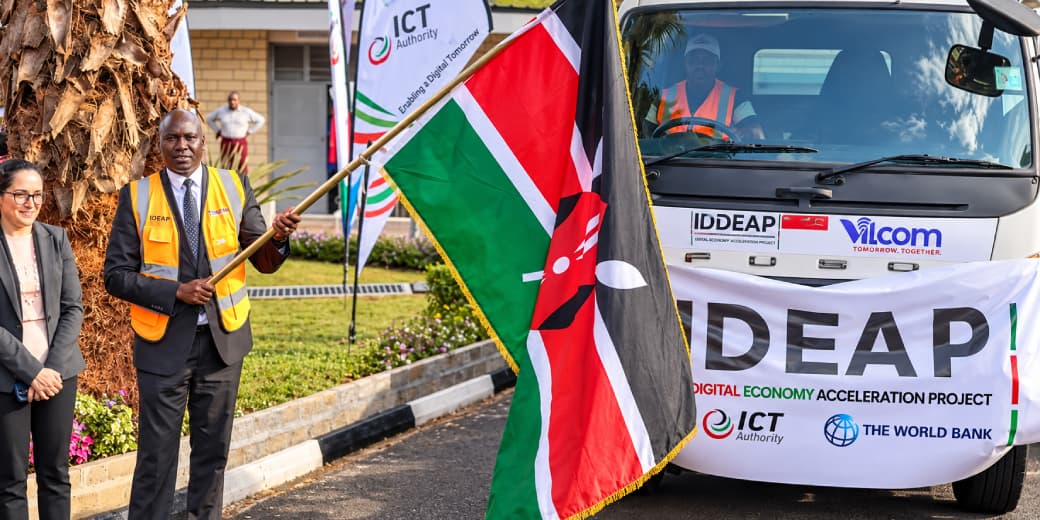
Kenya's rollout of interactive smartboards and teacher laptops to 10,382 public junior secondary schools launched with an official flag-off on June 9, 2026, under the World Bank-funded Kenya Digital Economy Acceleration Project (KDEAP), not this week.

Kenya has a new startup intelligence map, and its hardest job will be keeping the data trustworthy
A new independent platform maps Kenyan startups, investors, funding, hubs, policy and government programmes. Its value will depend on verification and freshness.

Agentic AI could cut the cost of running scams by 90 percent. Kenyan banks should treat that as an automation problem
The next fraud problem is not simply better phishing copy. Autonomous agents could make social engineering cheaper to run at enormous scale, forcing financial institutions to automate defence too.