

Africa cannot manufacture 60% of its vaccines by importing all the important knowledge
Manufacturing plants are only one part of vaccine sovereignty. Africa must own more of the science, delivery technology, intellectual property and market.
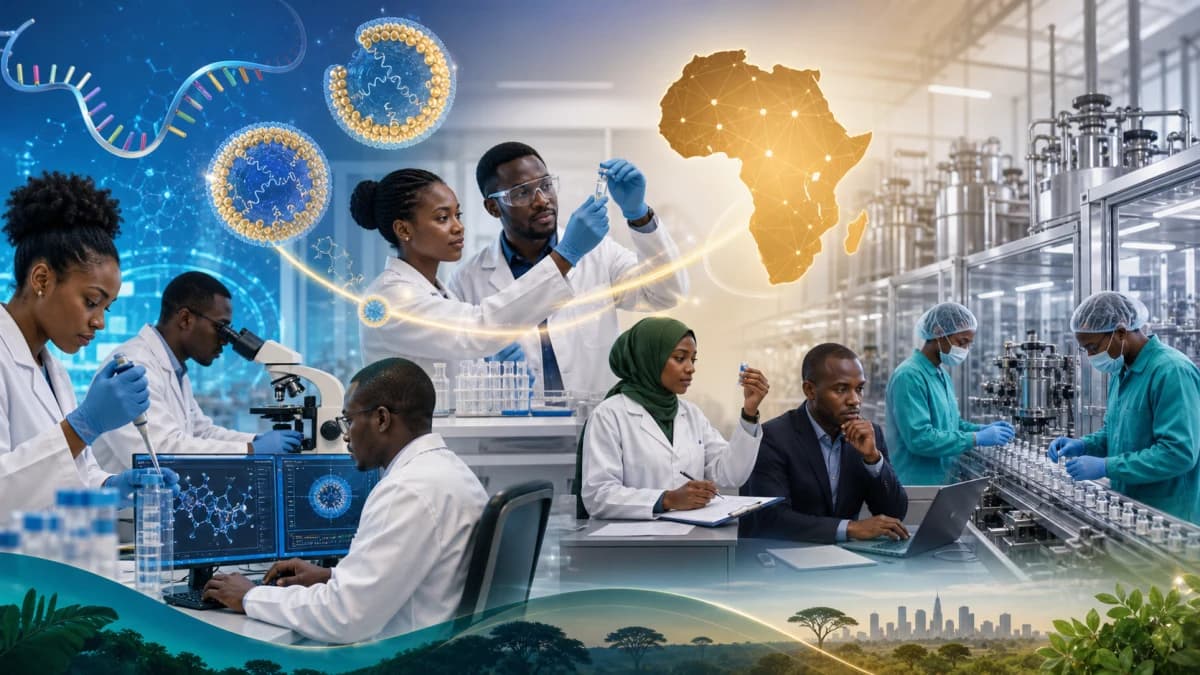
Africa currently manufactures about 1 percent of the vaccines it uses.
The Africa Centres for Disease Control and Prevention wants that figure to reach 60 percent by 2040.
Researchers from the University of the Witwatersrand argue that manufacturing capacity alone will not achieve the goal. The continent needs scientific expertise, intellectual property, regulatory strength, public procurement and functioning markets for African-made vaccines.
A factory that fills imported formulas into imported containers is useful.
It is not full technological sovereignty.
What you need to know
- Wits researchers published a strategic commentary in Communications Medicine.
- Africa produces roughly 1 percent of the vaccines it consumes.
- Africa CDC's target is 60 percent local production by 2040.
- mRNA is important because it is adaptable and can support rapid development.
- mRNA is not the only vaccine technology Africa needs.
- Intellectual property, regulation, procurement and sustained demand are critical.
- Wits researchers are developing lipid-delivery compounds from cashew-nut-shell waste.
- Africa needs ownership of science as well as manufacturing equipment.
What is mRNA vaccine technology?
An mRNA vaccine contains genetic instructions that tell cells to produce a harmless piece of a pathogen.
The immune system learns to recognise that piece and prepares a defence.
The platform became widely known through COVID-19 vaccines.
Its major advantage is adaptability. Scientists can design and test candidate vaccines relatively quickly once they know which pathogen target to use.
mRNA production can also use modular, cell-free processes rather than growing large quantities of a virus in biological systems.
That can make the platform easier to adapt across diseases and manufacturing sites.
It does not make mRNA a universal answer.
Different diseases and public-health needs may be better served by viral vectors, protein subunits or other platforms.
What COVID-19 exposed
The pandemic demonstrated that scientific success does not equitable supply.
Vaccines were developed rapidly, but richer countries secured early doses and manufacturing capacity. Many African countries depended on imports, donations and decisions made elsewhere.
By the time supply improved, public trust, demand and pandemic conditions had changed.
The lesson is not simply that Africa needed more factories in 2021.
It needed control over more stages:
- Research
- Clinical development
- Ingredients
- Intellectual property
- Regulation
- Manufacturing
- Procurement
- Distribution
- Pharmacovigilance
- Market planning
Dependency can enter at any stage.
Why intellectual property matters
A vaccine is more than the active genetic sequence.
It can involve protected knowledge around:
- Lipid nanoparticles
- Delivery systems
- Manufacturing processes
- Formulation
- Purification
- Quality control
- Equipment
- Software
- Patents
- Trade secrets
A manufacturer may own a building but still depend on foreign licences and components.
Wits researchers argue that African-owned intellectual property is necessary for long-term independence and freedom to operate.
This does not mean rejecting global partnerships.
It means negotiating relationships where African institutions learn, invent and own, rather than remaining permanent contract manufacturers.
What cashew waste has to do with vaccines
Wits researchers highlighted work using cashew nut shell liquid to develop ionisable lipids.
These lipids are important parts of the nanoparticles that protect mRNA and help deliver it into cells.
Cashew shells are widely available and often treated as agricultural waste.
The researchers say the resulting compounds have performed efficiently in preclinical formulations and may be cheaper than some licensed alternatives.
The science is promising. It is not yet the same as a mass-produced approved product.
Its strategic value lies in showing how local materials, chemistry and intellectual property can reduce reliance on a small number of foreign patent holders.
A waste product can become part of a sophisticated biotechnology stack.
That is a more interesting value chain than exporting the cashew and importing the vaccine.
The role of Afrigen and the technology-transfer hub
The World Health Organization and Medicines Patent Pool established an mRNA technology-transfer programme after COVID-19.
Afrigen Biologics and Vaccines in Cape Town became the central hub, with technology shared to partners through a hub-and-spoke model.
Wits' Antiviral Gene Therapy Research Unit contributed knowledge during the programme's early stages.
The model aims to create broader capability rather than a single protected facility.
The next challenge is sustainability.
Donor-funded technology transfer can build early expertise. Long-term manufacturing needs customers, contracts, working capital, regulatory approvals and a pipeline of products.
A facility cannot remain ready for the next pandemic by waiting quietly for the next pandemic.
Why regulation is part of manufacturing
Vaccines require strong national regulatory authorities.
They must inspect facilities, review clinical evidence, monitor safety and maintain international confidence.
The Wits commentary notes progress across African regulators, including several that have reached World Health Organization maturity level 3.
No African regulator has yet reached the highest level, although some are approaching it.
Regional harmonisation through the African Medicines Agency could reduce duplicated work and improve market access.
Regulatory sovereignty does not mean lowering standards.
It means having institutions capable of applying high standards locally.
The missing market problem
Africa can build manufacturing capacity and still lose it if buyers do not purchase the products.
Governments and global health organisations often buy through established international suppliers because prices, approvals and supply chains are familiar.
New African manufacturers may have higher initial costs and smaller volumes.
To survive, they need:
- Advance purchase commitments
- Regional pooled procurement
- Predictable government demand
- Competitive financing
- Export access
- Product pipelines beyond emergencies
- Support through early scale
- Transparent quality standards
Public procurement is industrial policy.
A government cannot demand local capacity in speeches and buy every dose elsewhere when tenders open.
Why 60 percent is harder than it sounds
A percentage target can hide different levels of capability.
One country may package imported bulk vaccine. Another may formulate, fill and finish. A third may develop the antigen, delivery system and manufacturing process locally.
All three can claim local production, but they do not hold the same technological power.
The target therefore needs clear definitions.
Policymakers should distinguish:
- Research and discovery
- Clinical development
- Active ingredient production
- Formulation
- Fill and finish
- Packaging
- Quality control
- Distribution
Without that detail, the continent could meet a numerical target while remaining dependent for the most valuable and difficult steps.
What skills the ecosystem needs
Vaccine sovereignty requires more than biomedical scientists.
It also needs:
- Chemical engineers
- Process engineers
- Quality specialists
- Regulatory scientists
- Clinical-trial managers
- Data scientists
- Cold-chain experts
- Intellectual-property lawyers
- Procurement professionals
- Manufacturing technicians
- Public-health communicators
These skills take years to develop.
A factory announced in 2038 cannot create an experienced workforce by 2040 through motivational speeches.
The training pipeline must begin long before the production target becomes politically urgent.
What the 60 percent target should measure
Counting finished doses alone can hide dependency.
Africa should also measure:
- Locally developed vaccine candidates
- African-owned patents
- Local ingredient production
- Clinical-trial leadership
- Skilled researchers
- Regulatory capacity
- Manufacturing uptime
- Regional procurement
- Technology exports
- Sustainable product pipelines
The goal is not to replace one import line with a local assembly line.
It is to create a biotechnology ecosystem that can respond to African priorities.
The tecMAMBO take
Africa's vaccine-sovereignty goal is technologically possible and economically difficult.
mRNA creates a valuable opportunity because the platform is adaptable and its manufacturing can be distributed.
The continent will not reach independence by purchasing sealed systems and calling them local.
It needs people who understand the chemistry, institutions that approve the product, companies that own valuable knowledge and governments willing to buy what they asked those companies to build.
Sovereignty begins when the manual is no longer the most valuable imported component.
FAQ
How many vaccines does Africa currently manufacture?
The Wits commentary estimates that Africa produces roughly 1 percent of the vaccines it uses.
What is Africa CDC's 2040 target?
The target is for Africa to manufacture 60 percent of the vaccines it needs by 2040.
Is mRNA the only technology Africa needs?
No. Researchers say mRNA should be part of a broader ecosystem that includes viral vectors, protein subunits and other platforms.
What is the Afrigen mRNA hub?
Afrigen in Cape Town is the central hub of the WHO and Medicines Patent Pool mRNA technology-transfer programme.
Why is intellectual property important for vaccine sovereignty?
Ownership and favourable licensing allow African scientists and manufacturers to develop, adapt and commercialise technology without permanent dependence on foreign patent holders.
Sources
Ask MAMBO
Have a plain-English question about this topic? Send it in and we may answer it in a future guide.
Ask a questionRelated reading
Kenya wants a licence built specifically for data centres, and operators have 30 days to weigh in
The Communications Authority of Kenya has opened a 30-day consultation on a standalone data centre licence, moving operators out of a broader telecoms category.

Apple lost its fight against EU app store rules. Now the deadline for compliance has a date
Apple's updated EU developer terms take effect October 1, 2026, following a July court ruling that rejected the company's challenge to its DMA obligations.

Kenya has a new startup intelligence map, and its hardest job will be keeping the data trustworthy
A new independent platform maps Kenyan startups, investors, funding, hubs, policy and government programmes. Its value will depend on verification and freshness.