

Your next Android flagship's chip can already act on its own. Here's what that actually means
Qualcomm's Snapdragon 8 Elite Gen 5 and MediaTek's Dimensity 9500 have both shipped with agentic AI built into their NPUs. Here's what's real and what's still rumor.
on phones isn't a 2027 feature to look forward to. It already shipped.
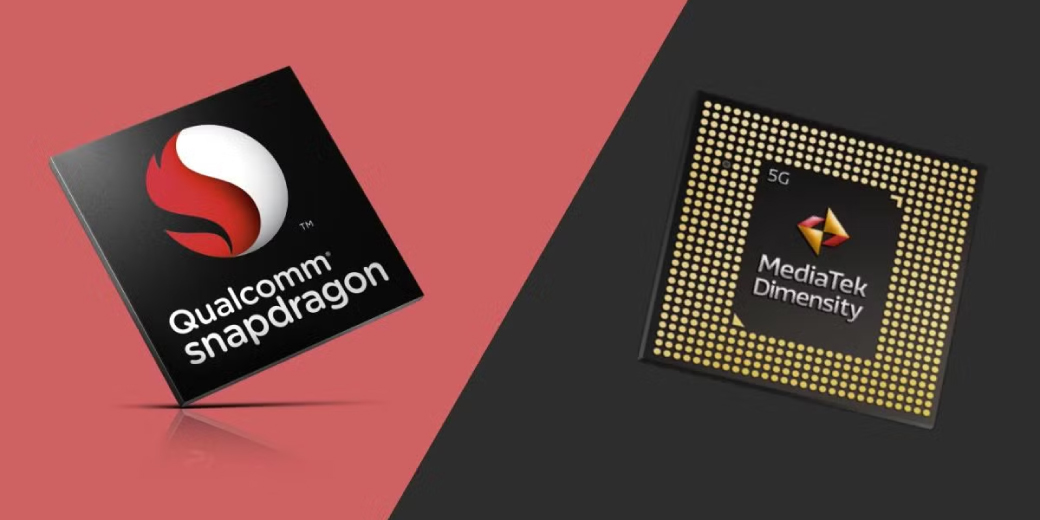
Qualcomm's Snapdragon 8 Elite Gen 5 and MediaTek's Dimensity 9500 are both current-generation flagship chips, already powering phones on the market, and both include NPUs specifically built around agentic AI, meaning the device can take multi-step actions on its own rather than simply answering a single prompt.
What's actually different between the two chips
MediaTek's Dimensity 9500 uses an all-big-core design built on TSMC's 3nm process, dropping the small efficiency cores most chips still rely on. MediaTek claims this yields roughly 32% better single-core and 17% better multi-core performance than the previous Dimensity 9400, alongside its NPU 990 chip, which the company says can double output speed while cutting model loading time by around 40%.
Qualcomm's Snapdragon 8 Elite Gen 5 pairs a Hexagon NPU with what Qualcomm describes as proactive, personalised . Independent benchmarking sites have put Qualcomm's peak NPU throughput at roughly 60 TOPS versus MediaTek's claimed 100 TOPS, though peak TOPS figures are a limited proxy for real-world AI performance and shouldn't be treated as the whole story.
The practical difference for a phone shopper: both chips now support running real, multi-step AI tasks directly on the device, from document summarization to meeting transcription to generative photo editing, without needing to send that data to . That's a meaningful shift for privacy-conscious buyers, not just a spec-sheet flex.
What's confirmed versus what's still rumor
Everything above is shipping hardware, already inside phones like the Galaxy Tab S11 Ultra and various Oppo and Vivo flagships.
What's still rumor is the next generation. MediaTek's Dimensity 9600 is expected to move to TSMC's more advanced 2nm process, according to tipster reporting, positioning it for 2027 flagship devices, possibly including future Oppo phones. Qualcomm's next Snapdragon generation for that same 2027 window hasn't been formally detailed yet. Treat any specific naming or spec claims about either company's 2027 silicon as unconfirmed until the companies themselves announce it.
The tecMAMBO take
The interesting story here isn't which chip wins a benchmark chart. It's that "agentic AI" stopped being a marketing phrase sometime in the past year and became a baseline flagship feature, the same way fingerprint sensors or displays once did.
For African markets specifically, on-device agentic processing matters more than it might elsewhere, because it reduces dependence on consistent, low- connectivity to get useful AI functionality. A phone that can summarize a document or edit a photo without a reliable data connection is a genuinely different value proposition in markets where connectivity quality varies by neighborhood, not just by country. That's arguably a more consequential shift for how flagship chips get evaluated in this region than the raw performance numbers themselves.
Sources
Ask MAMBO
Have a plain-English question about this topic? Send it in and we may answer it in a future guide.
Ask a questionRelated reading
 Should you care?
Apple's foldable finally arrives, and it's not even the biggest change at the company today
Apple's "Surprise and Shine" event brings the company's first foldable iPhone, new Pro models and a delayed budget lineup, all under new CEO John Ternus.
 MAMBO Explains
Agentic AI is moving onto the device, and chipmakers want the phone or PC to become the execution layer
Qualcomm and MediaTek are building hardware and software for AI agents that can reason and act locally, reducing cloud dependence for some tasks.
 Should you care?
Google Pixel 11 Series Arrives with Tensor G6, HiLight, Better Cameras and Higher Starting Prices
Google's Pixel 11 family is official, bringing Tensor G6, brighter displays, new camera hardware, Proactive Assistance, Qi2.2 charging and the return of notification lights through HiLight.