

Airtel Nigeria's one-seat shops show why telecom's future is still physical
The new compact shops reduce the cost of physical retail while keeping registration, support and financial services close to customers.
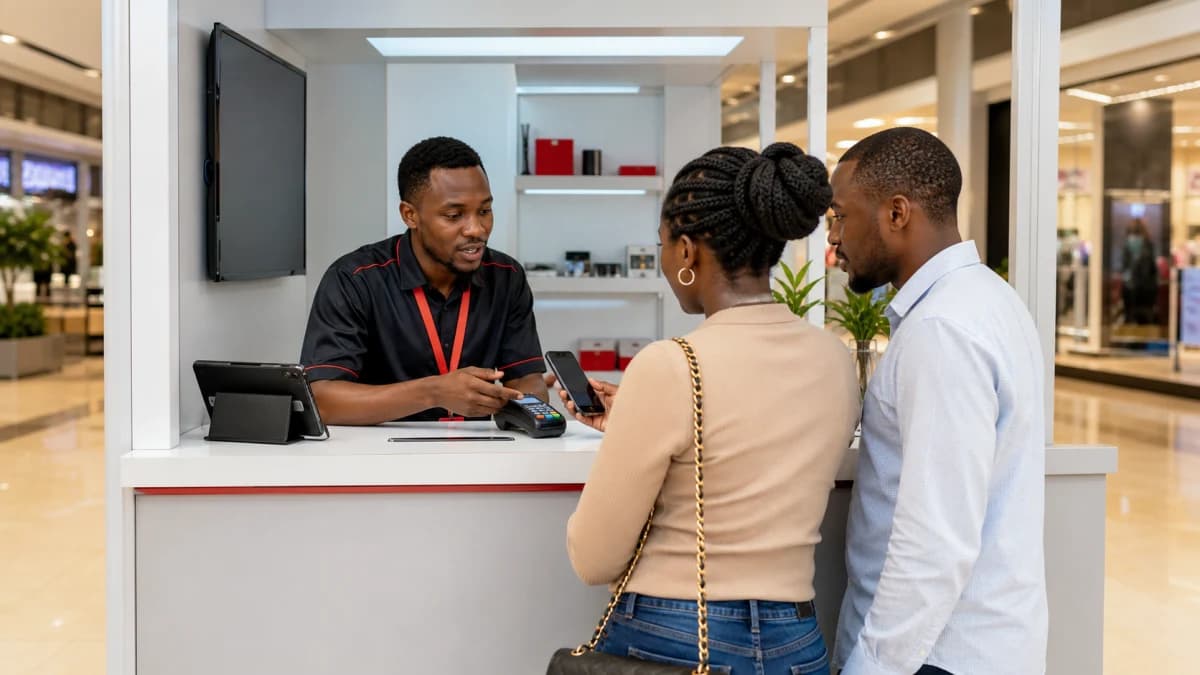
Airtel Nigeria has launched a compact retail format called Single-Seater Shops, beginning with an outlet opened at City Mall in Onikan, Lagos, on 28 July 2026.
The small stores are designed to extend products and customer service without the cost and space of a full branch.
At first glance, a one-person telecom shop looks like a minor retail experiment. It actually reveals an important truth about Africa's digital economy: an app cannot solve every problem created by identity checks, damaged devices, confusing data plans, SIM registration and .
What you need to know
- Airtel opened the first announced Single-Seater Shop at City Mall, Onikan.
- The company describes the concept as the beginning of a wider rollout.
- Airtel says its Nigerian retail network includes more than 200,000 customer touchpoints and over 4,000 exclusive shops.
- Compact shops can reduce rent and staffing costs.
- Physical access remains important for registration, troubleshooting, devices and financial services.
What is a single-seater shop?
It is a small retail point operated by one staff member.
The format can handle SIM registration, SIM replacement, account support, airtime and data, device assistance, product sales, mobile-money guidance and basic complaints.
The model sits between a full Airtel branch and an informal agent. It gives the company more control over branding and customer experience than an independent outlet while using less space and fewer staff than a conventional shop.
Why launch physical shops in a digital age?
Because telecom problems often begin when the digital channel is unavailable.
A customer may need help because a phone was stolen, a SIM stopped working, identity verification failed, data disappeared, a payment went missing or the customer has no data to open the support app.
Telling that person to open the app can become customer-service satire.
Physical retail creates an escalation path when automation fails.
Why small outlets make financial sense
Traditional branches carry rent, fit-out, security, power, connectivity, inventory and staffing costs.
A compact format can operate in malls, neighbourhood centres, transport corridors and smaller towns where a full branch would be difficult to justify.
The company can place more service points closer to customers while concentrating complex cases at larger centres.
The winning model is rarely online or offline. It is knowing which problem belongs where.
Can one person handle everything?
No.
A single employee has limited capacity. Complex fraud, enterprise accounts, legal disputes, technical repairs and large inventories need specialist support.
The format can also face long queues, staff absence, cash risk, limited privacy, inventory shortages, inconsistent training and difficult escalation.
Airtel should define which services each outlet can complete and how cases move to a larger support centre.
"One seat" should describe the floor plan, not the number of options left to the customer.
Why this matters beyond Nigeria
African telecom operators are becoming identity, connectivity and financial-service providers at once.
Many users still want a recognisable place and accountable person when money or identity is involved. Informal agents provide reach, but official outlets can offer stronger escalation and brand responsibility.
Compact retail could be especially useful in secondary towns and peri-urban areas where full stores are rare.
The rollout will matter more when it moves beyond the flagship Lagos site.
What Airtel should measure
A successful rollout should track customers served, waiting time, first-contact , escalation, fraud incidents, accessibility, regional coverage, staff safety and cost per resolved case.
Opening more shops is an input. Resolving more problems is the outcome.
What customers should expect from the compact format
A small outlet should not mean a smaller standard of consumer protection. Customers should receive clear identification of the staff member, official receipts, published service charges and a reference number for every unresolved case. Sensitive identity documents should be handled away from the view of people waiting nearby, even when the floor space is limited.
The shops also need reliable systems. SIM replacement and mobile-money support involve valuable identities and accounts. A weak connection, shared login or rushed verification process can create fraud opportunities. Airtel should use role-based access, automatic session locking, transaction logs and escalation for unusual requests.
Accessibility deserves attention. A one-seat kiosk may be difficult for wheelchair users, people who need seating, customers with hearing or visual impairments and anyone requiring a private conversation. The design should include an accessible counter where possible and a clear alternative channel where it is not.
Airtel should also avoid turning every support interaction into a sales pitch. Compact outlets will earn trust when staff solve the reason the customer arrived before promoting a new bundle or device.
The format succeeds when it feels like a capable service desk in a small footprint, not a branded table with limited authority.
A useful rollout would also test different neighbourhood types. A mall outlet, transport hub, university district and secondary-town centre will produce different customer needs. Airtel should not assume that one Lagos location proves the format everywhere. Pricing, language, queue patterns, device demand and fraud risks change by community. Publishing those lessons would make the expansion more credible and help regulators understand whether the format genuinely improves access.
The tecMAMBO take
Airtel's single-seater shop is a small physical answer to a large digital assumption.
Connectivity companies often behave as though every customer problem should disappear into an app.
Real life contains stolen phones, failed identity checks, cash, fear, language and confusion.
The future of telecom retail may be smaller. It will not be entirely virtual.
FAQ
Where did Airtel Nigeria open its first single-seater shop?
The announced flagship outlet opened at City Mall in Onikan, Lagos.
What services will the shops provide?
The format is intended to bring Airtel products and customer services closer to users. Exact services can vary by location.
Is Airtel replacing its larger shops?
The company describes the compact format as an expansion, not a complete replacement.
Why does a telecom company need physical shops?
Customers need in-person help for SIM registration, identity issues, devices, account recovery and payments.
Will the shops expand across Nigeria?
Airtel has described the opening as the start of a nationwide rollout. Customers should verify local openings through official channels.
Sources
Ask MAMBO
Have a plain-English question about this topic? Send it in and we may answer it in a future guide.
Ask a questionRelated reading

New leaders at the NSE and Airtel Kenya
The Nairobi Securities Exchange and Airtel Kenya have new leaders, with Tom Mulwa named NSE chairman and Djibril Tobe taking over as Airtel Kenya managing director.
South Africa sets six pillars for its digital economy
South Africa is framing its digital-economy push around six priorities: subsea cables and telecoms, AI, data centres, cybersecurity, startups, and cross-border digital transformation.
Airtime credit is back for millions of Nigerians
Airtime and data lending has resumed in Nigeria after a suspension linked to FCCPC digital-lending rules and a court fight.