
Visa and M-Pesa are testing stablecoins, but users may never see the crypto
Visa, M-PESA Africa and Onafriq are piloting stablecoin-based settlement for cross-border mobile money transactions in the Democratic Republic of the Congo.
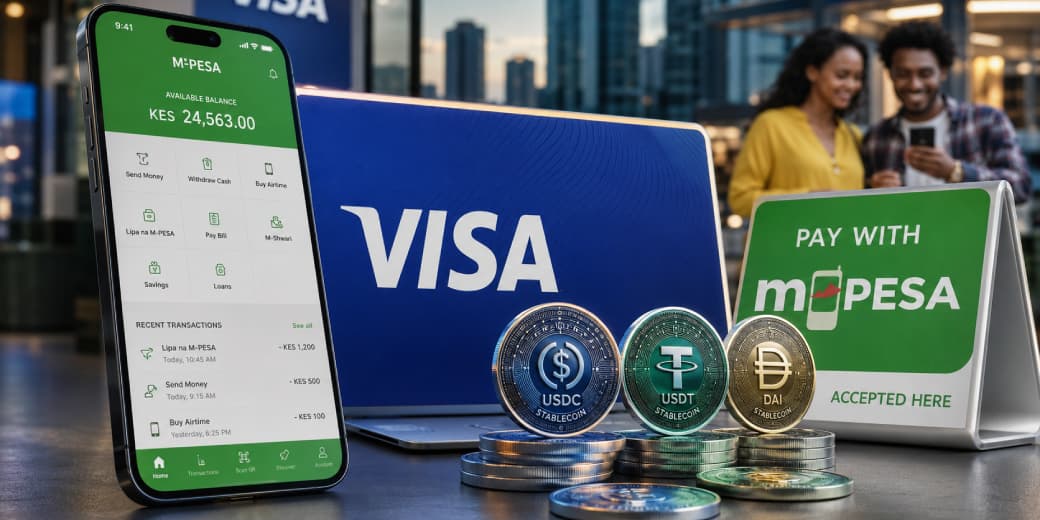
Visa, M-PESA Africa and Onafriq are piloting stablecoin-based settlement for cross-border mobile money transactions in the Democratic Republic of the Congo.
The important word is settlement.
The customer can continue using a familiar mobile money wallet while payment companies use a dollar-linked digital asset behind the scenes to move value between systems. If the pilot works as intended, users may experience faster or cheaper transfers without opening a crypto wallet, memorising a seed phrase or watching a chart.
This is how crypto becomes financial infrastructure: by becoming boring enough to disappear.
What you need to know
- The pilot begins in the DRC and focuses on cross-border .
- Stablecoins are used in the back-end settlement process.
- M-Pesa users are not necessarily receiving or holding cryptocurrency.
- Visa Pay and Onafriq connect payment and mobile money networks.
- The aim is faster settlement, lower cost and improved interoperability.
- Foreign-exchange, regulation, liquidity, consumer protection and dollarisation risks remain.
- A successful pilot would not automatically make every remittance cheaper.
What is being tested?
Cross-border payments involve more steps than the customer sees.
A transfer can pass through sending institutions, correspondent banks, foreign-exchange providers, regional payment networks, compliance checks and the receiving mobile money platform. Each handoff can add time, cost and reconciliation work.
The Visa, M-PESA Africa and Onafriq pilot tests whether a stablecoin can serve as a settlement asset between parts of that chain.
A stablecoin is a digital token designed to track the value of another asset, commonly the US dollar. Rather than waiting for traditional banking rails to settle every leg, participating institutions can transfer a tokenised dollar claim over a blockchain network and reconcile the final customer balance inside mobile money.
The user still sees local currency and a normal wallet experience.
The blockchain is plumbing, not the tap.
Why the DRC matters
The Democratic Republic of the Congo is a large, complex market with significant cross-border trade, migration and mobile money use.
Traditional banking access is uneven, while mobile wallets provide a practical financial layer for people and businesses. Cross-border transfers can remain expensive or slow because domestic mobile money success has not automatically solved regional settlement.
The pilot gives the partners a demanding environment in which to test interoperability.
Success in one corridor would not prove universal readiness. Regulation, currency controls, operator relationships and liquidity differ across African markets.
The DRC is a starting point, not a continental switch.
Why Visa is interested in stablecoins
Visa's business is moving value between institutions and merchants.
Stablecoins can offer faster availability, programmable settlement and round-the-clock transfer between approved participants. They may reduce the need for money to sit pre-funded in several accounts across several countries.
That can improve capital efficiency for payment companies.
Visa is not abandoning cards or banks. It is exploring another settlement rail and positioning itself so that blockchain payments still pass through Visa's network, compliance systems or partnerships.
The crypto revolution has a curious habit of inviting the existing payment giants to manage the revolution.
What Onafriq contributes
Onafriq connects mobile money systems and payment networks across African markets.
Its value is not only blockchain expertise. It is access to the fragmented last mile: mobile network operators, wallets, local currencies and regulatory relationships.
A stablecoin can move quickly between digital addresses. That speed means little if the value cannot enter or leave the mobile wallet that people actually use.
Onafriq helps bridge the global settlement layer and local distribution.
Could this reduce remittance costs?
Potentially, but the mechanism needs scrutiny.
Stablecoin settlement may reduce:
- Correspondent banking delays
- Pre-funding requirements
- Reconciliation friction
- Limited banking hours
- Some intermediary fees
- Failed or delayed handoffs
It does not remove:
- Foreign-exchange spreads
- Compliance and identity checks
- Mobile money withdrawal fees
- Taxes
- Agent commissions
- Fraud losses
- Liquidity costs
- Customer support
- Regulatory capital
- Commercial profit margins
A cheaper back end does not a cheaper customer price. Companies may keep some efficiency as margin.
The pilot should therefore be judged by actual transfer cost, delivery time, failure rate and transparency, not by the word "blockchain" in the announcement.
What are the risks?
Dollarisation
A dollar-pegged settlement asset can deepen dependence on the US dollar, especially in countries with fragile local currencies.
Even if customers never hold the token, the infrastructure may shift more financial power toward dollar liquidity and foreign issuers.
Issuer and reserve risk
A stablecoin is only as reliable as its reserves, redemption system, legal structure and operational security.
"Stable" is a design promise, not a law of nature.
Regulation
Authorities need clarity on licensing, capital flows, anti-money-laundering rules, data access, consumer recourse and currency policy.
Blockchain and custody risk
Smart-contract flaws, compromised keys, frozen assets or network outages can affect settlement.
Concentration
The system could reduce dependence on correspondent banks while creating dependence on a small group of stablecoin issuers and global payment companies.
New rails can still lead to old toll booths.
Why this is more important than another crypto trading app
Africa's largest crypto opportunity may not be speculation.
It may be invisible financial coordination: settling trade, moving remittances, connecting mobile wallets and reducing the capital trapped between incompatible systems.
That does not require every customer to become a crypto user.
The strongest infrastructure succeeds when people receive the benefit without needing to understand the implementation. Few M-Pesa users think about database replication when sending money. Stablecoins may reach maturity when they become equally unremarkable.
The tecMAMBO take
The DRC pilot is a serious signal that stablecoins are moving into mainstream payment infrastructure.
It is not proof that crypto has solved African remittances. It is not M-Pesa turning customers into token holders. It is a test of whether digital dollars can improve the back office while leaving the front office familiar.
The right question is not whether the pilot uses blockchain.
The right question is whether a Congolese customer sends more money home, pays less, receives it faster and has someone accountable when the transfer fails.
FAQ
Are M-Pesa customers receiving stablecoins?
The pilot is described as using stablecoins behind the scenes for settlement. Customers can continue interacting with mobile money rather than directly holding crypto.
Which country is hosting the pilot?
The initial pilot is in the Democratic Republic of the Congo.
What does Onafriq do?
Onafriq connects payment and mobile money networks across African markets, helping funds move between otherwise separate systems.
Will stablecoins make remittances instant?
They can speed up part of the settlement process, but compliance, foreign exchange, wallet processing and operational checks can still affect delivery time.
Are stablecoins risk-free?
No. Risks include reserves, redemption, regulation, custody, technology, liquidity and dependence on the issuing company.
Sources
Ask MAMBO
Have a plain-English question about this topic? Send it in and we may answer it in a future guide.
Ask a questionRelated reading
 Business
Safaricom's new board appointments show what Vodacom's 55% control looks like in practice
Safaricom's appointment of two senior Vodacom executives is more than a routine board refresh. It shows how the telco's new majority ownership is beginning to shape governance.
 MAMBO Take
M-Pesa Ethiopia users can now turn wallet balance into cash at Bank of Abyssinia ATMs
A new Bank of Abyssinia integration gives M-Pesa Ethiopia customers another way to cash out, turning existing ATM infrastructure into part of the mobile-money network.
 MAMBO Take
Visa's new East Africa chief comes from mobile money, and that changes the strategy
Visa has appointed an executive who grew a mobile money challenger. Her task is to connect cards, wallets, banks and merchants across seven markets.